Taproot at 10: Still building after Launch Party 7

On Oct. 20, 2016, Karen and I spent an evening explaining Taproot Edmonton to curious people at Startup Edmonton’s Launch Party 7. Ten years later, we look back on that night as a key milestone in our journey.

We had introduced Taproot a few months earlier, and our first story was published that September. Members were asking questions in our Story Garden and helping to cultivate one another’s ideas. Our elevator pitch that night captures just how early we were in the process:

Karen Unland:

"I’m Karen Unland, this is Mack Male, and we’re making Taproot Edmonton.

"Taproot is a source of curiosity-driven stories about our city, cultivated by the community.

“We are building a new way to do local journalism, and a new way to fund it. We don’t sell eyeballs, and we don’t put up paywalls. We enlist our members to tell us what they’re curious about, we commission writers to answer their questions, and we pay those writers from the membership fees we collect. Then we publish the story for all to see.”

Mack Male:

"Why are we doing this? The business model that used to support local journalism is broken. We want to replace what is being lost with something that is sustainable and responsive to the community we serve.

"Edmonton is full of smart, observant people, and that makes this a good place to develop this idea. But every mid-sized city has this problem. If we can make something that works here, we can transplant the process to other cities, and strengthen local journalism everywhere.

“We currently have more than 50 paying members, and we have published two stories based on their ideas, with more to come. We want you to join us, so come see us at our table, or visit taprootedmonton.ca.”

The pitch was short but the work that went into it was anything but. We spent weeks preparing, refining what we wanted to say, and updating our website to have something tangible to show attendees.

“That was a great opportunity for us to refine our message and to tell our story to a whole new group of people,” I wrote in January 2017. “We spent the entire evening talking to curious people about Taproot and what we’re up to. It was great to hear encouragement, feedback, and constructive criticism.”
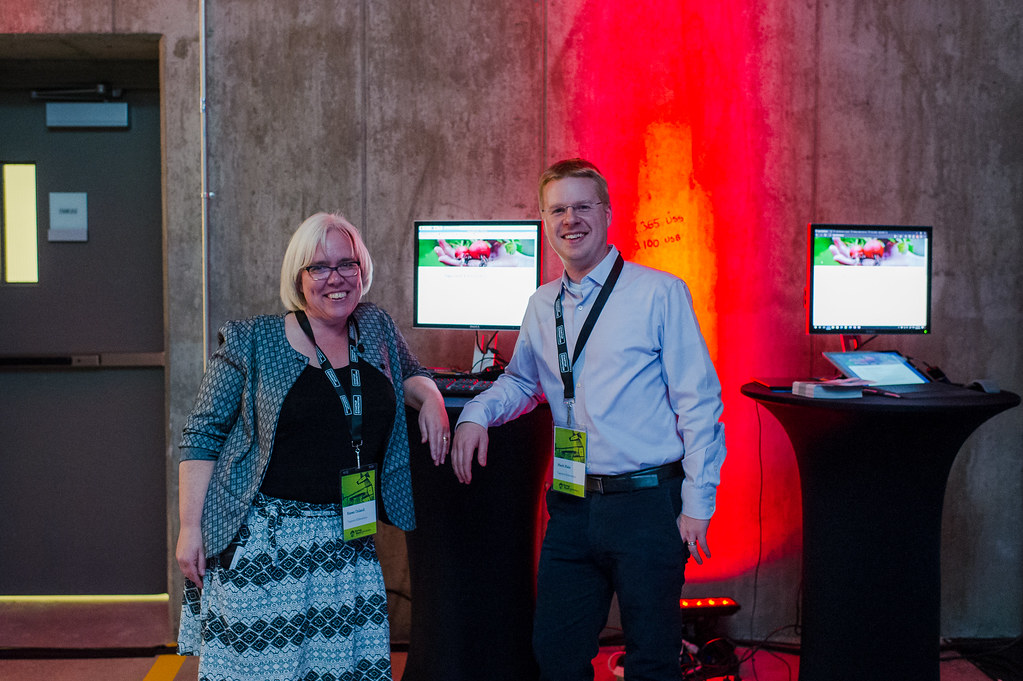
Karen Unland and Mack Male at Startup Edmonton’s Launch Party 7 on Oct. 20, 2016. (Ampersand Grey/Flickr)

Ten years is a long time for a startup, and the fact that we’re still here to mark the anniversary is something to celebrate. I’m grateful that we have been able to build on that night, though as you might expect Taproot looks quite different today! Looking back at our fellow participants also reveals how much can grow from one evening’s introductions.

Our Launch Party 7 cohort

Unfortunately, little remains online about Launch Party 7. I might have blogged about it, but I think I was just too busy getting ready for the event! Edmonton Unlimited’s alumni page preserves the cohort’s companies and founders, and an archived Launch Party 7 page has the original company descriptions. Here’s the cohort, including the founders listed at the time:

There were tools for lawyers, filmmakers, software developers, and homeowners, alongside games, virtual reality, and our attempt to build a future for local journalism. The subsequent stories have taken some interesting turns.

A decade of new directions

RUNWITHIT Synthetics’s original pitch focused on simulating activity to test the performance of apps, devices, and servers. The company went on to apply its technology to entire communities. In 2023, we reported on its synthetic model of the Edmonton region, which let decision-makers explore hydrogen adoption and regional growth through to 2050. A year later, the Bittners told us how a $3.5-million investment from Raven Indigenous Capital Partners would help put their tools into more people’s hands.

vrCAVE began with Hospital of Horror, a shared virtual-reality haunted house. Watching people navigate those experiences together led the Rossol brothers to another application: understanding how people communicate and solve problems. We covered that journey into hiring and team development through AlignVR in 2022. By February 2026, vrCAVE had launched 10 escape-room games and was preparing its first game for people to play together from home.

dealcloser set out to spare lawyers the manual work of organizing documents and signatures to close transactions. We reported on its $1.75-million seed round in 2021. Ten years on from Launch Party, the company is still growing. It formalized its European expansion in September 2025, adding support and workflows tailored to firms there. In March 2026, it launched Cloe, an artificial intelligence assistant built into its platform and designed to help legal teams manage signatures, automate tasks, and track deal progress.

Our reporting also followed Reshef into another industry. As CEO of Fairly Staffing, he brought his product experience and investor relationships to Aisha Abdul’s platform connecting dental clinics with temporary workers. When we spoke to them in May 2026, Fairly served 600 clinics and 3,000 dental temps. Fairly was itself a Launch Party participant in 2024.

FilmReel powered by FAVA grew from the Film and Video Arts Society of Alberta’s need to manage memberships, equipment, facilities, and creative work. Its software journey continued as AMS Network, whose website reports use by more than 100 institutions nationwide and still lists Cunningham and Scholotiuk on its team. Scholotiuk’s filmmaking has also appeared in our Arts Roundup: Northern Gateway Films earned seven 2026 Rosie nominations for My Final Victim and another for The Speech.

ThirtyThree came to Launch Party with RunGunJumpGun, a game combining its founders’ design, development, and musical skills. Its portfolio now also lists COPE from 2019, APES.io from 2022, and Rebounder as its current project. The studio’s work offers another example of a creative endeavour extending well beyond its first launch.

TradePros connected homeowners with home improvement professionals. Co-founders Kyle Jeske and Jon Smelquist are now both at Smart Access. We covered Smart Access’s $12 million series A raise earlier this year.

And there is a particularly fitting connection back to Launch Party: vrCAVE co-founder Viinikka became CEO of Edmonton Unlimited in 2024, joining the organization carrying on the event that had helped introduce his own venture.

Building something that lasts

Our own journey has involved plenty of changes, too. In that January 2017 update, I was celebrating our incorporation as Taproot Publishing Inc., approaching 100 members, and having published four stories. We were also thinking about how to follow issues over time, beyond answering a single question.

That ongoing attention became central to our work. We launched the Tech Roundup and Speaking Municipally in 2018, then The Pulse in 2021. Later, the Taproot Edmonton Calendar and our election tools gave people more ways to understand and participate in their community. Our history page tells that longer story.

Our coverage of the Launch Party 7 cohort is a great example of the reliable intelligence we provide. We have been able to follow companies as they raised money, changed direction, developed products, and found new problems to solve. Those stories, interviews, and roundup items now form a record that makes this retrospective possible.

The ongoing attention we pay to companies and people in our community is part of what makes Taproot valuable and unique. A funding announcement matters, but so does understanding what came before it and following what happens next. We help people see connections, find opportunities, and understand how Edmonton is changing.

I’m glad Taproot is still here to do that work, and I’m grateful to our team, members, advertisers, sponsors, partners, and everyone who has shared their curiosity with us and supported our work. Congratulations to our fellow Launch Party founders on the work they have done over the past decade.

If you value the attention we pay to the Edmonton region, become a member to help sustain it. You’ll also gain access to members-only content, weekly perks, and more.

Taproot wins award for excellence in journalism

Taproot co-founders Mack Male and Karen Unland accepted the Dr. Eric Jackman Award for Excellence in Journalism in the small media category via video on June 10, 2026.

The Canadian Journalism Foundation presents this award to recognize news organizations that “embrace journalistic excellence — originality, courage, independence, accuracy, social responsibility, accountability and diversity — resulting in a positive impact on the communities they serve.” We won in the small-media category; the large-media winner was W5/CTV News for Sleeping with the Enemy, an investigation into a global ring of men who sexually exploit their partners and share the abuse online.

We were unable to attend the ceremony in Toronto on June 10, but the organizers were kind enough to allow us to express our gratitude via video. As we said in our speech, we knew we wanted to do work that mattered when we started Taproot 10 years ago, but we didn’t know what that would look like then, and we could never have imagined being recognized on such a stage.

The gala honoured many stellar journalists: Alexios Mantzarlis of Indicator for AI safety reporting; Chloe Williams and Gavin John of The Narwhal for climate solutions reporting; and Emma Jarratt of the Investigative Journalism Bureau for coverage of women’s equality issues. Robert Fife and Susanne Craig were also honoured for their storied careers, and a number of fellowships were announced, including the Martin Wise Goodman Canadian Nieman Fellowship for Edmonton’s own Amber Bracken.

It’s a tremendous honour to find ourselves among such luminaries. We salute the CJF for making it possible to recognize the work of small outlets like Taproot and our fellow nominees for the Jackman award: The Green Line, the Investigative Journalism Foundation in collaboration with The Narwhal, The Sprawl, and The Trillium. Lots of us are out here doing useful, important work on relatively small budgets, and it’s encouraging to see those efforts validated.

As we’ve said before, we don’t do the work for awards, but it feels good to be nominated and even better to win. We hope everyone who has ever supported Taproot shares in the pride we’re feeling today. And if you’d like to say congratulations, buying a membership for yourself, your organization, or a friend would be a great way to convey the message!

Taproot at 10: Celebrating the beginning

Ten years ago this week, we took our first step toward finding out whether Taproot was worth building.

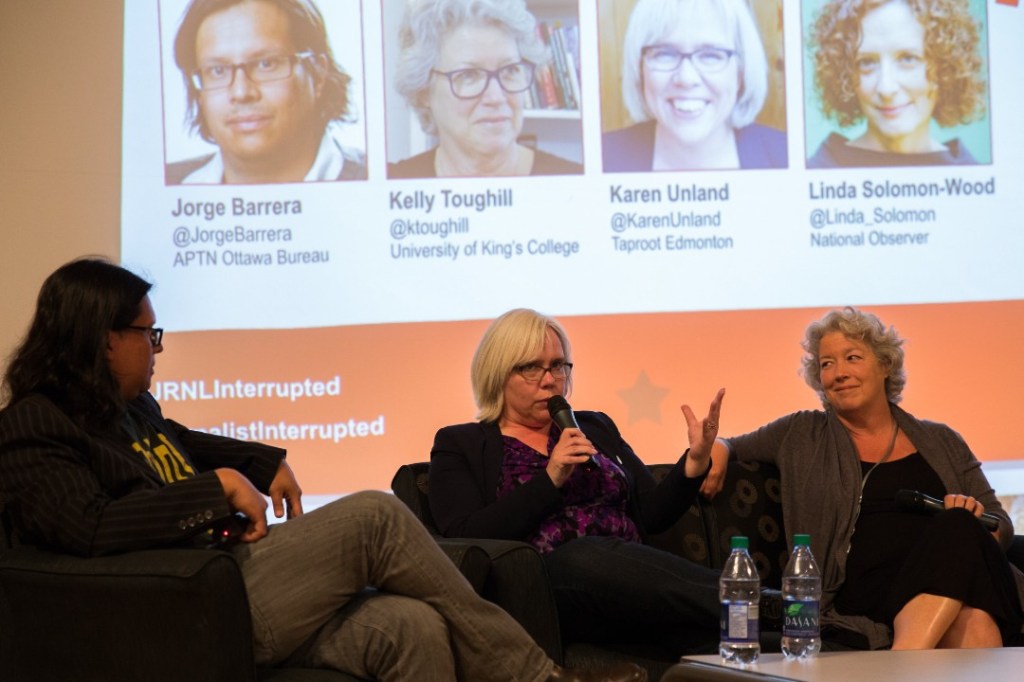
Karen Unland makes a point while Jorge Barrera and Kelly Toughill look on at Journalist Interrupted, an event at MacEwan University on May 26, 2016. (Mack Male/Flickr)

Mack and I had been working on the idea since January of 2016, after Postmedia merged the newsrooms of the Edmonton Journal and the Edmonton Sun and let go of dozens of journalists here and in three other cities. We did not think this would be the end of the shrinking of local media, and we felt called to do something about it.

We had landed on a name — taproots like radishes and carrots grow well in Edmonton, and we thought we might, too. We’d decided on a business model, inviting people to become members in return for the ability to express what they were curious about, and enlisting them to help us make our work freely available to everyone. But we didn’t know if anyone wanted what we were making.

Trish Audette-Longo, a former colleague of mine from the Journal who had moved into academia, gave us an occasion on which to find out. Her response to that January bloodletting was to organize an event with Brian Gorman of MacEwan University, timed to closely follow the Canadian Association of Journalists conference that was in Edmonton that year. They invited Linda Solomon-Wood of the National Observer, Kelly Toughill of the University of King’s College, Jorge Barrera of APTN, and me from the heretofore unknown Taproot Edmonton to speak at an event called Journalist Interrupted on May 26, 2016.

We had a landing page up that night, inviting people to become members for $10 a month or $100 a year. As near as we can tell, no one took us up on it at the event, but Mack’s blog post made the case in a more actionable way.

“Taproot is a home for local journalism that is created with the community rather than simply for it,” he wrote. “It’s our attempt to figure out what the future of local journalism looks like and we’d love for you to be a part of it!”

Enough people signalled their interest with their credit cards to persuade us it was worth continuing. And so we did.

“I am so excited to build this with you and with our community,” I commented on Mack’s post. “It feels like every conversation we’ve ever had about journalism (and we’ve had a lot) is now converted into action. We’re going to learn a lot, and make lots of mistakes, no doubt. But this is what we’re meant to do.”

It’s been a long, winding road since then, which you can read all about on our updated history page.

This kicks off the first in an occasional series of posts on how Taproot came to be, as we mark milestones up until the 10th anniversary of our incorporation in January 2027.

Many thanks to all of those who helped us get here, especially those early adopters, some of whom are still with us! Be like them and become a member. You’ll help Taproot continue to accomplish what we set out to do all those years ago.

Accessibility and design improvements across Taproot

Delivering reliable intelligence to our community means thinking about how to serve the entire community. Accessibility is a big part of that. As we approach our 10th anniversary (more on that in an upcoming post), we have been reviewing everything we have built over the years, to ensure it aligns with our values and vision for the future. With the help of our readers, we identified accessibility and design as key areas for improvement.

Over the last decade we have built many things that we’re proud of. We have also made many mistakes along the way! With limited resources, we have had to make trade-offs. We solved problems as they came up, and many of the design choices across our websites and emails accumulated organically. Now, we have made a concerted effort to review and refresh our design, in alignment with our news on purpose philosophy.

What we heard

In our 2026 audience survey, design and readability emerged as a top area for improvement. Colours and contrast came up frequently. “The colors of links which are hard to read early in the morning in dark mode!” one respondent wrote. “But I switch to light mode and it’s livable.” Another suggested a refresh was in order. “A more aesthetically pleasing, user friendly, and inviting website would be a huge benefit,” the person wrote. “It looks a little better in ‘light mode’ as opposed to ‘dark’ but I think refresh would be great.”

We are grateful for the feedback. It helped us prioritize this work and make sure we were focused on the right things.

Our approach

We’re not experts in accessibility or design, and we remain resource-constrained. But we’re curious, and as journalists, we know a thing or two about research and iteration. Those skills served us well as we dove into this project.

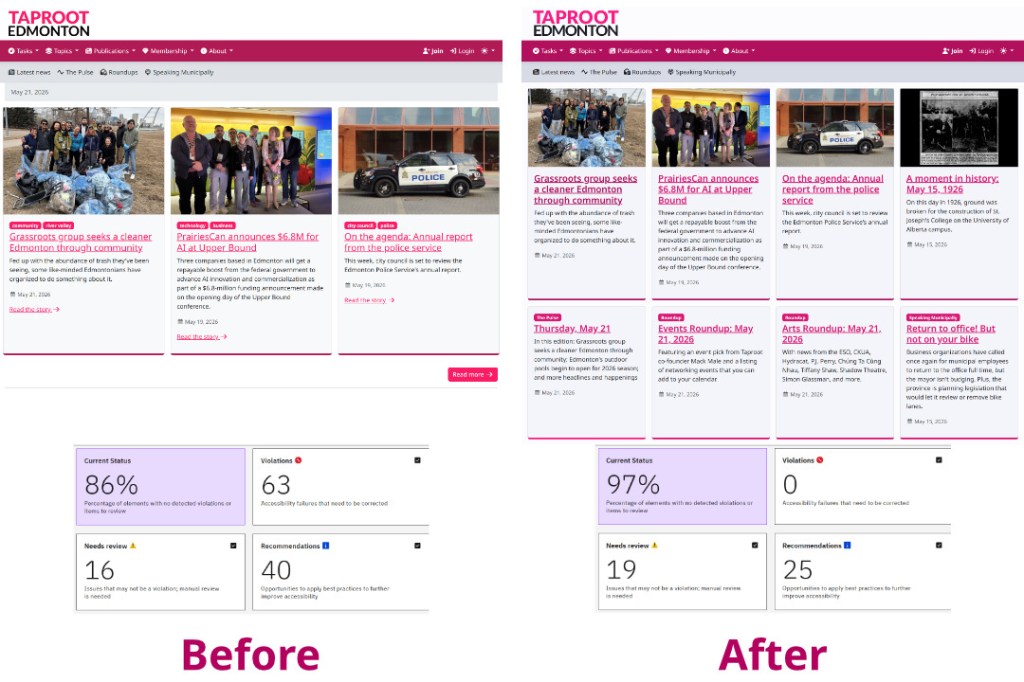
We decided to focus on incremental improvements rather than a complete redesign. While we did make improvements across our news, calendar, and vote sites, we focused most of our attention on the news site, where the majority of our readers spend their time.

To guide our work, we leaned on the Web Content Accessibility Guidelines (WCAG) and the Accessible Rich Internet Applications (ARIA) standards. We used several tools to audit our sites and ensure we were making meaningful improvements along the way, including Lighthouse, axe, and IBM’s Equal Access Checker. We also did some testing with NVDA, a popular screen reader.

What we changed

We made dozens of changes across our websites and emails, but several bigger ones are worth highlighting.

We started with colour. Pink was a very intentional choice when we started Taproot. After we settled on the concept of a taproot, we thought about which plant might represent it best. We chose the radish, in part because they grow well in the Edmonton region, and in part because they are pink. We wanted something different from the usual red, green, blue, and orange that you typically see in media and politics.

However, the specific shade of pink we chose was not very intentional. We used some stock art for an early mockup and simply adopted the pink from that. We didn’t think about contrast or readability at the time. We were too busy trying to get Taproot off the ground! Over time we brought in other colours, but again without much thought to how they worked together or how they affected readability.

We have now selected a new primary pink and developed a palette of supporting colours that improves contrast and readability across light and dark modes. This addressed a lot of the issues the accessibility tools flagged.

Next, we moved on to typography. We decided to keep the same fonts, but we did adjust the colours, weight, spacing, line width, and other details that affect the readability of our work. We also cleaned up our logo, adjusting its spacing and applying the updated colours.

Other changes we made to the websites include:

  • Headings now follow the correct hierarchy and are used appropriately. We had been using heading levels in some places purely for styling, which creates problems for people who navigate with assistive technology.
  • We added skip-to-main-content links, so keyboard and screen reader users can bypass navigation and get straight to the content.
  • We simplified page layouts by removing redundant “Read the story” links and other unnecessary elements.
  • Ads are now consistent across the site and emails, so they look and behave the same way everywhere.

We also refreshed our email templates. Over time, they had become brittle as we tweaked things by hand, one change at a time. We now have a repeatable pipeline that makes it easier to update templates consistently and reliably.

We tried to take what we did on the web and apply the same principles to email. That is harder to do than it sounds, as email client support is varied and limited in ways the web is not. Still, we managed to make some important contrast and readability improvements in our emails, while also making them more consistent with the web experience.

The impact

Our accessibility score on Lighthouse improved from 84 to 100 on our home page, and from 91 to 100 on a typical article page. We also saw significant decreases in the number of issues flagged by other tools, in most cases from dozens to zero.

This is great progress! But we know there is more to do. Accessibility is an ongoing commitment, and we will continue to make improvements.

Undertaking this work has also led us think more deeply about how the products we build serve our community and our mission. We have lots of ideas for how to improve our websites and emails in ways that go beyond accessibility, and we look forward to sharing those with you in the coming months.

We hope these accessibility improvements make Taproot easier to use for everyone, whether you rely on a screen reader, have low vision, prefer dark mode, or simply want a less cluttered reading experience.

Let us know what you think of the changes!

Taproot Survey earns more award nominations

Taproot’s 2025 municipal election project has earned two new award nominations, from the Canadian Journalism Foundation and the National Media Awards Foundation.

We previously shared that the Taproot Survey was a finalist for a National Newspaper Award in the Innovation in Journalism category. While we did not win that one, we remain endlessly proud to have been a finalist. Congratulations to the winners, Cody Gault and Lucas Timmons of the Toronto Star, for their automated natural language search engine that provided real-time riding data for all 343 ridings in the 2025 federal election, and to our fellow runners-up at Canada’s National Observer for Civic Searchlight, a tool that transcribes municipal council meetings.

Now, we’re thrilled to share that our election project is a finalist for the Dr. Eric Jackman Award for Excellence in Journalism from the Canadian Journalism Foundation, and for the Innovation in Digital Storytelling category at the Digital Publishing Awards from the National Media Awards Foundation.

CJF Dr. Eric Jackman Award for Excellence in Journalism

The CJF award honours “news organizations that embody exemplary journalism and have a profound positive impact on the communities they serve.” The Taproot Survey was highlighted as a way to “focus on the issues that mattered most to voters instead of the horse race,” along with our accompanying election coverage.

We’re in very good company on the list of finalists. Also up for the award in the small media category are The Green Line in Toronto for a series on the effects of LRT construction on housing; the Investigative Journalism Foundation in collaboration with The Narwhal for a series on gas companies avoiding regulation in B.C.; The Sprawl for coverage of Calgary’s municipal election; and The Trillium’s work to expose patronage in the deployment of a skills development fund in Ontario.

The finalists in the large media category are APTN, The Canadian Press, CBC News, Le Devoir, and CTV News. The winners will be announced on June 10 in Toronto.

Digital Publishing Awards

The Innovation in Digital Storytelling category of the Digital Publishing Awards honours “an innovative digital creation, project or concept … to enhance the storytelling, the audience engagement and/or experience.” Our election site, including the Taproot Survey, was nominated for this award.

Other finalists include FAIT QUE, a “living journalism lab” for people aged 18 to 35; The Feathertale Review for Issue #29, which it describes as “the world’s first fully audible issue of an award-winning magazine”; and The Green Line for How to Toronto: Our No-BS Guide to City Living.

The winners will be announced on June 5 in Toronto.

Support our award-worthy work

We don’t do this work for awards, but it is welcome validation for the quality of what the Taproot team produced, and a great indication that those who have helped us along the way have made a wise investment.

If you would like to help us do more, refer a friend, buy a membership, or consider sponsorship or advertising, depending on your circumstances. Your support makes it possible for us to do work that informs, connects, and empowers the Edmonton region. Thank you!

How we use artificial intelligence at Taproot

At Taproot, we believe trust is built not only by what we publish, but by being clear about how we work. Transparency about the tools we use and the standards we hold ourselves to underpins our ability to deliver reliable intelligence about the communities we serve.

We have now published a policy on artificial intelligence. We use AI to help make our work more efficient, accessible, and useful, while keeping our journalism human-led, human-edited, and human-accountable.

In the long term, we may not need a separate AI policy at all, as our existing ethics policy covers the principles that guide our work regardless of the tools we use. But in the short term, AI is changing quickly, public interest is high, and there is understandable uncertainty about what AI use actually means in practice. For now, we think it is better to be explicit about how we use these tools.

Why we are using AI

We are using AI to help our team do more valuable work and spend more of its time where human judgment matters most.

We understand that some people feel strongly that AI should not be used at all. We respect that view, but we do not share it. We think AI can be a useful tool when used responsibly. It is clear that AI is here to stay, and is even being incorporated into tools we already use, whether we like it or not. We think the right approach is to use AI thoughtfully, with transparency and accountability, rather than trying to swim upstream against the tide of technology.

We use AI for tasks such as summarizing information, brainstorming questions, generating first drafts, detecting spelling and grammar issues, assisting with research, analyzing large datasets, and transcribing interviews. We also use AI for coding and product development, business operations, and other non-editorial tasks.

In every case, a human remains responsible for reviewing, checking, and deciding whether and how the work will be used.

How we actually use AI

We view AI primarily as a tool. Like other tools, it can be used thoughtfully or poorly. As you might expect, we have put a lot of thought into how we use it!

We do not go to a chatbot and say, “write an article about X” and then publish what comes back. That kind of approach produces AI slop, and it is not what we do.

Instead, we build and use agents. An LLM agent runs tools in a loop to achieve a goal. (LLM stands for large language model, which is the type of AI we generally use.)

For example, we have developed an agent to generate first drafts of written work. We provide the agent with a set of instructions, transcripts of interviews, and reporting notes. We also equip the agent to use tools for things such as accessing our archives and incorporating our style guide. The agent produces a first draft that is constrained by our instructions, shaped by our reporting, and ready for human input and editing. Before the draft is published, it follows the same editorial process as our pre-AI drafts did: It is revised, edited, fact-checked, and reviewed by at least one human editor.

We developed this agent by identifying and documenting the steps we would normally take to produce a first draft. We then built a system that can follow those steps, using AI to help with the parts that are more mechanical and time-consuming. This approach allows us to benefit from the efficiency of AI while keeping our work human-led and human-edited.

We deployed our first agents earlier this year, and will continue to iterate on our approach as we learn more about what works and what doesn’t. Using agents like this changes the way we work, but it doesn’t change the necessary conditions for good work. Garbage in, garbage out still applies!

We have high expectations for quality, with or without AI. It has been an interesting challenge to figure out how to “teach” an agent to meet those standards. The process of doing that has helped us clarify, document, and improve our own internal processes. This is a welcome side effect of using AI the way we do.

When we disclose AI use

In the same way that we do not disclose every use of a spell-checker, we don’t think every use of AI needs to be individually disclosed. That said, readers deserve to know when AI has played a significant role in the work they are seeing.

For example, when we use AI to analyze material at a scale that would not otherwise have been practical, we disclose that. We used LLMs to help analyze the input we gathered during our 2025 election project, and we disclosed that.

We avoid generating visuals with AI. There are interesting and potentially appropriate use cases, and we do not rule them out in principle, but if we ever use AI-generated visual material, we would disclose that clearly.

Our policy also commits us to disclosing AI use where a reader could reasonably feel misled if we did not explain how AI was used. That is a bit of a judgment call, but as always, we will err on the side of transparency.

What’s next

Journalism has always evolved alongside technology. New tools often arrive with uncertainty, debate, and strong opinions. Over time, some become ordinary parts of the workflow. We expect many AI tools will follow a similar path.

We are optimistic about the potential of AI to assist us in achieving our mission to help communities understand themselves better. We are also clear-eyed about the risks and challenges, and we are committed to using AI in a way that is consistent with our values.

We invite you to read our Artificial Intelligence Policy. If you have questions about how we use AI at Taproot, please get in touch.

Taproot Survey earns nod from National Newspaper Awards

Taproot’s effort to help voters make an informed decision in the 2025 municipal election is a finalist for a National Newspaper Award in the Innovation in Journalism category.

The Taproot Survey, a big part of our election coverage, earned Taproot recognition for the first time from these awards celebrating excellence in Canadian journalism. We’re so proud to see our team’s hard work honoured in this way!

Taproot is the only Edmonton media outlet to be named a finalist for this year’s NNAs; the only other Edmonton-based nominee is Jana Pruden of The Globe and Mail, who is nominated for sports reporting. As you might expect from the name of the awards, Canada’s biggest newspapers figure heavily among the finalists, but it’s great to see the program recognize smaller and digital-only publications like ours as well. Our fellow first-timers include The Green Line and Village Media’s Sudbury.com for local reporting and The Tyee for arts and entertainment coverage.

This is the first time the NNAs have included a category for innovation in journalism. The other finalists are a team from Canada’s National Observer for Civic Searchlight, which makes it possible to search transcripts of municipal meetings, and a team from the Toronto Star for an automated natural-language search engine to provide real-time data for all of the ridings in the 2025 federal election. We’ll learn who wins on April 24.

We don’t do this work for awards — truly, the greatest reward was helping 27,000+ people see how they aligned with the candidates for mayor and council on the issues that mattered most to them. But it is welcome validation for the quality of the work the Taproot team produced, and a great indication that those who have helped us along the way have made a wise investment.

And so, I hope those who support Taproot feel as happy as we do today. Without you, we would not be able to do such work! If you would like to help us do more, refer a friend, buy a membership, or consider sponsorship or advertising, depending on your circumstances. Every little bit has brought us to where we are.

What we learned from Taproot’s 2026 audience survey

We recently completed our second annual audience survey. We wanted to learn more about who our readers, listeners, and viewers are, how they use Taproot, and what they want more (or less) of. Building on the insights from last year’s survey, we wanted to see how things have changed and get more specific feedback on what we can do better.

And because Taproot is intentionally built to refrain from tracking you around the internet, the best way for us to learn is simple: We ask.

Hundreds of people took the time to respond to our audience survey again this year. Thank you!

We heard so many positive and encouraging comments from respondents. “Your work is appreciated. I am grateful for a reliable source of local journalism,” one person said. “Keep up the good work — I’d be lost without you,” said another.

Here’s a snapshot of what else we heard:

People recommend Taproot

We included a standard question that is typically found on surveys like this: “How likely are you to recommend Taproot to a friend or colleague?” This is the question that forms the basis of the net promoter score (NPS), which is a widely used metric for measuring customer satisfaction.

Based on this year’s responses, Taproot’s NPS is 57. That’s a strong score, especially considering that media and news organizations often score in the 20 to 40 range.

This metric, taken together with the many positive comments we received, suggests we are delivering real value to our readers and listeners.

“Keep it up! You’re a ray of hope in the bleakness of our current news landscape,” one person said. “Thanks for all you do! I consider Taproot an invaluable part of the Edmonton community,” said another.

Taproot helps people feel informed and connected

The survey results suggest that Taproot is doing a good job of meeting some core needs for our audience:

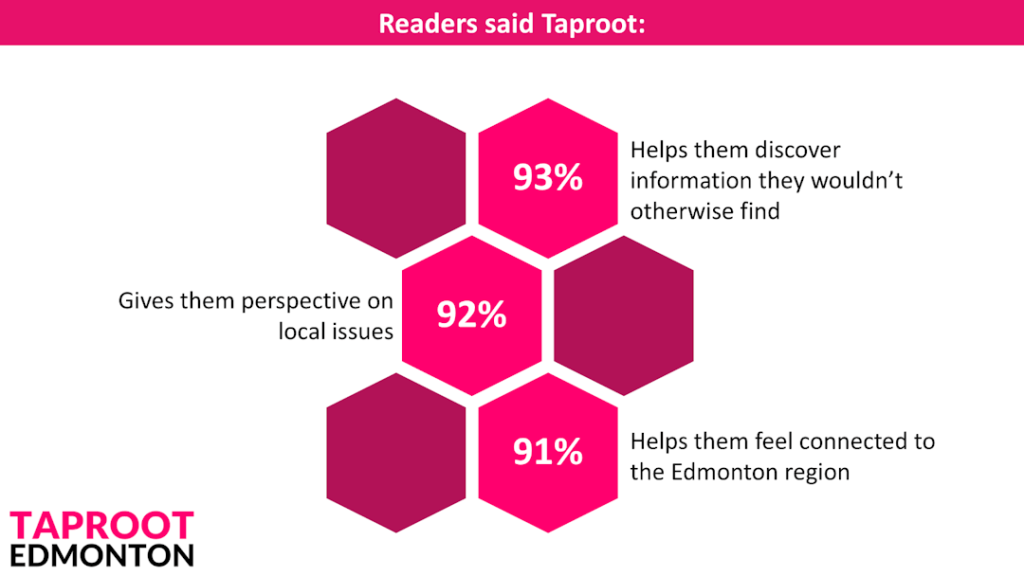
  • 90% of respondents said Taproot helps them feel informed about what’s happening in the Edmonton region.
  • 88% said Taproot helps them feel connected to the Edmonton region.

The comments we received reinforced this. “Taproot has been my preferred way to remain engaged with what is happening in the Edmonton region, and has increased the amount of opportunities for me to engage locally,” one person said.

When we grouped responses into broader “user needs,” the strongest results were:

  • Informed: 94% net-positive
  • Connected: 81% net-positive
  • Delighted: 83% net-positive
  • Enlightened: 79% net-positive

We have identified six of these needs, based on the user needs for news model that publications around the world have used to guide their work and measure their impact.

The other two — Inspired at 60% net-positive and Helped at 42% net-positive — offer some clear opportunities for improvement.

Impact has always been a challenging thing for us to measure. Adopting a user needs framework is one way to get a better understanding of how we’re doing, and you’ll see us use this framework more in the future.

Taproot’s audience supports local

This year’s survey results once again confirmed that Taproot readers and listeners are people who invest locally.

In the past month:

  • 83% dined at a local restaurant.
  • 77% bought something from a locally owned business.

And when it comes to buying local products:

  • 73% would pay slightly more for local.
  • 19% would pay significantly more for local.

For businesses that sponsor or advertise with Taproot, this matters. It means their message reaches people who already care about supporting the Edmonton region.

But what really stood out was how respondents interpreted that support:

“I think businesses that sponsor Taproot show that they care about local journalism. I am more likely to support their business versus an ad I see on YouTube or Spotify.”

That’s the kind of relationship we want to foster: sponsorship and advertising that reinforces the idea that we’re all building the Edmonton region together.

We have started publishing more sponsored content in the past year, so we wanted to understand how that is affecting the Taproot experience:

  • 73% said it either enhances (10%) or has no effect (63%) on their experience.
  • 11% said it diminishes their experience.

That’s encouraging. We see sponsored content as a way to serve our audience, our advertisers, and Taproot all at the same time. We’ll continue to be thoughtful about how sponsored content is produced and presented.

Built to respect time and attention

Respondents told us they have different rhythms for staying on top of the news:

  • 53% enjoy consuming news multiple times throughout the day.
  • 40% prefer to check news once a day.

One comment captured the “sweet spot” we aim for.

“I like that Taproot provides me with a good amount of local news and information that I can easily digest in the morning. Not too much information to feel overwhelming, with a focus on local.”

Some people want more content, others want less. Some want it more frequently, others want it once a day. Some want it in their inbox, others prefer to check the website. We’re always trying to find the right balance, and we know there is no one-size-fits-all solution.

That said, we think the desire for trustworthy, local news and information is common across all of these different preferences. Taproot is intentionally built to respect time and attention, and to avoid clickbait, outrage, or manipulation.

As we explore new ways to make Taproot more accessible and convenient, we will build on this foundational principle.

Opportunities for improvement

We asked: “If you could change one thing about Taproot, what would you change — and why?”

The largest group of respondents said they wouldn’t change anything. Keep up the great work, they told us!

Many others shared thoughtful feedback about how we can improve. A few clear themes stood out:

  1. Design/readability: Improving the navigation, design, and accessibility of our website and other products is a top priority. We made some big strides last fall with the launch of our election website, but there is still much to do.
  2. Calendar improvements: Respondents told us they want more listings, better search and filtering, and several other improvements to make the Taproot Edmonton Calendar more useful. We launched some of these improvements in November, and we will continue to use this feedback to guide future improvements.
  3. Delivery preferences: Everyone has different rhythms and preferences for consuming news, and sometimes Taproot doesn’t fit those. We’re thinking about how to give people more control over email frequency, consolidation, and more. We share your desire for an app!

We also heard suggestions for new types of content, feedback on Speaking Municipally, and concerns about transparency. We are taking all of this feedback seriously and will use it to guide our work in the coming months.

Become a member to support Taproot

If Taproot helps you feel informed, connected, and engaged in the Edmonton region, membership is the best way to support our work.

Become a member, either as an individual or as an organization, and you’ll help us provide reliable intelligence about the Edmonton region without paywalls or intrusive ads. You’ll also enjoy the benefits of membership, including weekly giveaways and discounts, access to our Taproot Exchange livestream series, and more.

“I think I get great value for my membership. Keep it up!”

If you want to support Taproot but aren’t ready to become a member, you can also make a one-time contribution. Every bit helps.

And if you want to support Taproot without spending money, the best thing you can do is simple: Tell more people about Taproot. The more people who read, share, and support Taproot, the more we can do to serve the Edmonton region.

Thanks again to everyone who took the time to respond — and to everyone who chooses Taproot. We’re grateful to be a part of your day.

P.S. If you’re reading this and thinking to yourself, “Those are the people I want to reach!”, consider advertising with Taproot. We’d love to help you reach our thoughtful, engaged, and local audience.

How Taproot Edmonton made an impact in 2025

We embarked on 2025 with a clear mission: to inform, connect, and empower our community with reliable intelligence. It was a year that tested our capacity and proved our value, as we navigated challenging economic times, covered a pivotal municipal election, and deepened our engagement with the Edmonton region.

The result was our most impactful year yet. We saw unprecedented growth in our audience, with overall website traffic more than tripling alongside meaningful increases in subscribers and members. But the numbers only tell part of the story. The real impact is found in the voters who felt prepared for the ballot box, the residents who discovered new ways to participate in their city, and the recognition we received for our collaborative approach to journalism.

An award-winning year

Early in the year, our commitment to serving the community was recognized on an international stage. Housing Complex, our series exploring Edmonton’s housing system, was named a Collaboration of the Year at the 2025 LION Publishers Sustainability Awards.

Taproot Edmonton won a Collaboration of the Year award from LION Publishers for Housing Complex, our series on Edmonton’s housing system. (Taproot Edmonton)

The project, which launched in 2024, was a partnership with the Edmonton Coalition on Housing and Homelessness funded in part by the Alberta Real Estate Foundation. It exemplified what we strive for: journalism that goes deep, works with the community, and seeks solutions.

“Hands down, this is a tour de force of the power of collaboration and the power of serving your community with high-quality journalism delivered with care, respect, and depth,” the judges noted. This accolade set the tone for a year defined by impactful, service-oriented reporting.

Helping voters make informed choices

Our most significant undertaking in 2025 was our comprehensive election project. We knew that to serve our city effectively, we needed to help voters cut through the noise. The centrepiece of this effort was the Taproot Survey. By asking candidates for mayor and city council to respond to key questions, we created a unique tool used by more than 27,000 voters to compare their views with those of the candidates.

“Before I was made aware of the Taproot Election project I was struggling to understand who the other candidates in my ward were and what they stood for,” said Sonia P. “Taproot really allowed me to clarify my own positions and those of the candidates out there. It was just a superb use of technology plus journalism. Honestly, it was an amazing community service.”

The response was overwhelming. Our election website became a hub for civic engagement, drawing nearly 160,000 unique visitors. Beyond the digital tools, we fostered real-world connection through listening sessions, partnerships with 32 local organizations, and a mayoral forum co-hosted with the Edmonton Public Library.

Readers such as Guy M. called the Taproot Survey “an extraordinary gift to the community where traditional media has abandoned us,” noting that it “helped illustrate the complex job that it is to be a member of council making tough choices with limited options.”

“Taproot’s coverage of the 2025 Municipal Election proved, once again, just how vital local media is to our society,” added Kevin J. “A strong, informative independent media outlet is so beneficial and we need more of it. So thank you for all your tireless efforts. It has not gone unnoticed.”

The election project is a powerful example of the unique impact we can make by blending technology, product thinking, and editorial craft to build tools and experiences that make local information more useful.

You can read more about this massive effort in our election project wrap-up.

Informing with reliable intelligence

While the election was a major focus, our team continued to deliver the daily intelligence that keeps Edmontonians connected to their city. Whether through in-depth reporting or the bite-sized updates in The Pulse, we are designed for signal, not extraction, ensuring our readers have an accurate, trustworthy snapshot of the region.

The scale of this operation has grown significantly. In 2025, we sent 1.7 million emails across hundreds of campaigns. Despite this high volume, our readers remained highly engaged, with an impressive 56.2% open rate. This consistency matters. As reader Jodi M. shared, “I start every morning reading The Pulse. I am always delighted by the news that it contains. By reading it, I feel better informed and more a part of the Edmonton community.”

This trust translated into substantial audience growth, with traffic to our primary news website surging by more than 244%. We were also thrilled to see our individual membership base expand by 37%, reflecting a growing community that values our work.

Connecting the community

A vibrant city is one where people show up, and we are proud to help make that happen. The Taproot Edmonton Calendar has become an essential utility, with our team curating and adding more than 7,200 events in 2025 alone.

“The Calendar has been the cherry on top for me, as it always excites me when I find something cool happening in the city that I can go check out over the weekend,” says Thiago V., a newcomer to Edmonton.

We also kept a close watch on the pulse of various sectors through our weekly roundups. Relentlessly focused on local, we connect the dots across the ecosystem to help our community understand itself better. We tracked thousands of headlines and events related to the arts, business, food, tech, and more, helping our readers stay informed about the communities they care about.

On the audio front, Speaking Municipally continued to lead the conversation on civic affairs. With nearly 60,000 downloads in 2025, the podcast surpassed 300,000 all-time downloads, cementing its place as a “must-listen” for engaged citizens.

Perhaps unsurprisingly, the most popular episodes were those focused on the municipal election:

  1. Episode 331: Return of the Knack
  2. Episode 309: He’s got a Knack for winning elections
  3. Episode 315: You’re out of order! You’re out of order! This whole council is out of order!
  4. Episode 329: Patience is a virtue
  5. Episode 332: The heart berry opens, a chapter closes

I guess we should get Mayor Knack on the show again in 2026!

Setting the agenda and inspiring through stories

The reporting our team undertook this year sparked curiosity and drove conversations.

The stories that resonated most with our readers reflected a city in transition, grappling with growth, governance, and identity. From the dissolution of regional partnerships to the future of our downtown mall, here are the stories that stood out in 2025:

  1. Three municipalities finalize departure from Edmonton Global
  2. Teresa Spinelli doubles down on Little Italy as cooperative dissolves
  3. Edmonton votes 2025: What we know so far
  4. Debate grows as Edmonton plans 23 km of new active transportation infrastructure for 2025
  5. Controversial casino licence changes hands in $5.8M deal
  6. Visionary says Edmonton needs to look elsewhere to re-imagine its downtown mall
  7. Duchess buys up space on 124 Street to consolidate operations
  8. Campaign aims to see Edmonton cut the lawn and replace with gardens, native plants
  9. Edmonton ‘still not ready’ as 2024 population growth exceeded even breakneck forecast: Knack
  10. ETS begins adding small surcharge for big-name concert tickets at Commonwealth

We also found ways to include joy and delight in The Pulse. We published 46 “A moment in history” articles, and launched the Taproot Mini, a daily crossword created by Edmonton puzzle-maker Brandon Cathcart.

Join us in building an informed community

This work of informing, connecting, and empowering is only possible because of our community. In 2025, we welcomed more supporters than ever before. We’re deeply grateful to each and every one of you who read, share, and contribute to Taproot Edmonton.

If you value reliable intelligence about the Edmonton region and want to see this work continue, please consider becoming a member.

Here’s to another year of growth and impact in 2026!

The Taproot Edmonton Calendar gets a major update

When we launched the Taproot Edmonton Calendar, we did it because we kept hearing the same thing over and over: it’s surprisingly hard to find out what’s going on in time to actually take part.

Since then, the calendar has grown into a core part of what Taproot Edmonton does. It powers event listings in The Pulse, the Events Roundup, and our other newsletters, it helps people plan their evenings and weekends, and we regularly hear from readers that it has become one of their favourite things we offer.

In November we launched a major update to the calendar that incorporates feedback from users, improves the user experience, and provides a stronger foundation for future enhancements.

What’s new in this release

This update is a long overdue refresh that brings the calendar in line with our news and vote sites, and adds a number of features that make it easier to find what you’re looking for. We have officially taken the calendar out of beta!

A cleaner, more cohesive design

The calendar now shares the same header and navigation structure as our news and election sites, so moving between them feels more seamless. It should be easier to jump from reading the latest news to finding upcoming events in the calendar.

We’ve also reduced duplication on the front page so you are more likely to see a wide variety of events at a glance, rather than the same listings repeated in multiple sections.

Multiple ways to view events

Everyone browses events a little differently, so we’ve added a layout toolbar to every page that lists events. You can now choose:

  • Cards: the visual layout you’re used to, with images.
  • Compact cards: a more streamlined view without images.
  • Table: a spreadsheet-style view that’s great for scanning dates, times, and locations quickly.
  • List: a simple, text-forward presentation.

Pick the layout that works best for you; the calendar will remember your choice, and you can change it any time with a click.

Search and better filtering

You can now search the calendar from the box at the top of every page, or use the dedicated search page to dig deeper. Today’s search is a straightforward keyword match on event titles, organizers, and locations, with some helpful shortcuts like “start:today” to zero in on what’s happening right now.

We’ve also expanded the filter options so you can narrow things down by criteria such as time of day, alongside the categories, dates, and locations that were already available. This should make it easier to find, say, family-friendly events on Saturday afternoons, or talks and panels after work.

Behind-the-scenes improvements

We have also made several technical improvements that will help us keep the calendar running smoothly as it continues to grow. These include:

  • Better handling of images to improve reliability and speed.
  • Spam filtering to reduce the number of inappropriate events submitted.

Why this matters to us (and, we hope, to you)

The Taproot Edmonton Calendar is not a side project. It is one of the most important ways we help the Edmonton region understand itself better.

Events are where ideas are shared, relationships are built, and communities take shape. A well-curated, reliable events calendar is part of the connective tissue that helps our community function. That’s why we’re continuing to invest in it.

How you can help the calendar grow

Here are some ways you can support and benefit from the Taproot Edmonton Calendar:

  • Use the calendar: Visit edmonton.taproot.events when you’re planning your week, or when someone asks, “What’s going on in Edmonton?”
  • Submit your events: If you host events in the Edmonton region, please submit them to the calendar. It is free and easy to do, and helps more people find out about what you’re doing.
  • Share it: Tell your friends, colleagues, and communities about the calendar and our Events Roundup newsletter so more people can discover what’s happening.
  • Support our work: If you’re in a position to do so, becoming a Taproot member helps sustain the calendar and all the other work we do to keep our community informed and connected.

What’s next?

We have several additional improvements to the calendar in the works, including:

  • Personalization options for Taproot members, such as saving events to a personal calendar.
  • Enhanced search and filtering capabilities, especially related to geography.
  • More ways to browse related events, such as guides for specific interests or themes.

We’re also excited about better integrating the calendar with our news site, to provide a more holistic view of what’s happening in the Edmonton region.

If you have feedback, spot a bug, or have an idea for how the Taproot Edmonton Calendar could serve you better, please get in touch.