Readers offer guidance on how to grow membership

“Don’t ask, don’t get.” We often cite those four words from Amanda Wagner, delivered during an accelerator that Taproot co-founder Mack Male and I attended in 2019. This month, that mantra led us to ask for information from the people who read Taproot but are not paying members. Their answers were revealing.

Why did we ask?

Taproot’s journalism has always been freely accessible. We believe a paywall would stand in the way of our mission to inform and connect the Edmonton region. But we have also always made it possible to buy memberships for $10 per month or $100 per year. This was our first revenue stream, and it remains an important source of funding to pay the people who carry out our mission.

About 6% of the people on our current mailing list pay for Taproot memberships. We wanted to better understand what has stopped the 94% from becoming paying members.

What did we ask?

On Sept. 4, we sent them a survey asking them to indicate what has stopped them from becoming paying members of Taproot. We gave them the opportunity to choose up to three responses from a list of reasons:

  • I didn’t know paid membership was an option
  • I don’t know how to become a paying member
  • I don’t get enough value from what Taproot publishes to pay for it
  • Taproot doesn’t offer enough extra benefits to members
  • I can’t afford the current price
  • I reserve my media budget for news outlets with paywalls
  • I am already a paying member under a different email address
  • Someone else in my household is already a paying members
  • I want to know what Taproot publishes but I don’t want to support it
  • Other

We also invited them to tell us more about their answer.

What have we learned so far?

The email containing the survey was opened by about half of the recipients, and of those, about 8% answered it. So this is based on a small sample of our total readership. Still, the responses offered some useful guidance.

We need to improve our communications about membership

The answer with the most responses was “I didn’t know paid membership was an option.” Coupled with a few more responses indicating people knew membership was possible but didn’t know how to buy it, it’s clear that we need to make that option clearer and the path more obvious.

It didn’t take much of a nudge for some of the survey recipients to take the next step and start paying — at least a dozen upgraded to paid memberships shortly after the email went out. We asked and we got!

The Tyee has a message from the publisher at the bottom of every article encouraging readers to become paying members and explaining how they are contributing to free access for all. CKUA makes a similar pitch — you don’t have to pay to enjoy it, but if you do, you contribute to the station’s sustainability. We’ll be taking inspiration from these and other sources as we make our pitch more explicit on the Taproot Edmonton website.

We’ll also update our signup page and integrate information about our new Business Membership, which allows companies to sign up all of their staff, ensuring a well-informed workforce while supporting our efforts to continue to provide that information.

Some might pay if membership cost less

We heard from some people that $100 a year or $10 a month is a heavy lift, especially with so many other subscriptions pulling on the pocketbook.

Membership prices have stayed the same since we launched the first version of Taproot in 2016, aside from an increase when we got big enough to have to charge GST. There wasn’t a lot of science behind the price points we chose. We needed to see if people believed in the idea enough to join; $100 a year or $10 a month was memorable and made for easy math.

Perhaps different membership tiers would make it possible for more people to support us monetarily. A one-time donation option may appeal to some. Or maybe we should take a page from some of our friends in the arts community and institute a pay-what-you-can system. We’ll take it all under advisement.

Also, we know there’s interest in being able to claim the digital news subscription tax credit. Taproot hasn’t been eligible in the past, but we’re getting closer to qualifying, and we hope to have some good news to share before the end of the year.

Some might pay if benefits were beefed up

We don’t do tote bags at Taproot (at least not yet). So what do you get if you’re a member?

Initially, paid members had exclusive access to our “story garden,” a place to plant seeds of curiosity, some of which would grow into full-fledged stories that we would pay freelancers to write. It was an innovative concept, but it was hard to respond to all of the ideas in a timely way, even with a small minority of our members engaging. As our business model and editorial practices evolved, we closed the story garden.

For a while, free readers were limited to two weekly roundups, while paying members had access to as many as they wanted. In 2023, we lifted that restriction (but didn’t ballyhoo the change — if you’re a free reader, go ahead and update your preferences to get as many newsletters as you want, including the new Events Roundup).

Right now, the main benefit of paying for Taproot is the warm feeling you get from knowing you are supporting independent local journalism and making it possible for everyone to consume it. That is valuable, as the Membership Puzzle found in a study of news sites around the world. “(Many) supporters of open access news sites say they’re aware that they’re paying for the site’s work as a voluntary act that subsidizes journalism for others,” it noted. “But this is a point of pride, not frustration, for most of them.”

And yet, it’s understandable to expect membership to have its privileges.

Our managing editor, Tim Querengesser, is experimenting with members-only listening sessions as a way to tap into the curiosity of our biggest supporters. In the inaugural session held online on Sept. 13, participants said they wanted not only to interact with Taproot staff but also with each other, preferably in person. (We’ll share more about what we learned in the coming days.) Based on previous experiences with the recent Speaking Municipally live show and other collaborations with Let’s Find Out, we know the power of real-life interaction with our community. One of our survey respondents went further, suggesting that members-only networking events could be particularly enticing if they provided “an inside track to meet the movers and shakers in Edmonton that you’re writing about.” There’s definitely something to explore there.

In the absence of defined benefits, it’s hard for readers to imagine what else we could do that might persuade them to become paying members. Our plan is to follow up this survey with another one that asks about various potential perks to see what would be the most enticing.

Some might pay if we published more of our own journalism

Taproot publishes at least one original story based on our own reporting every weekday, and Speaking Municipally rounds out the week with original commentary on what went on at city hall. Much of the rest of our output is curated from other sources, whether it be the Headlines that summarize recent news in The Pulse, or the items collected in our weekly roundups on Tech, Food, Health, the Region, Arts, and Business. The Taproot Edmonton Calendar, which feeds the “Happenings” files in our newsletters, is also a product of curation.

Much of this is by design. We subscribe to Jeff Jarvis’s credo: “Cover what you do best. Link to the rest.” We happily point to the work of “the competition,” which is a service to our readers, while reserving our resources for stories that no one else is doing. Curation also allows us to bring our readers much more information than a small newsroom could otherwise provide. In a given week, Taproot publishes about 20,000 finely crafted words — that’s a lot for this many people, and it’s only possible because of a methodology we’ve honed over many years, assisted by technology that Mack has developed from scratch. That “pay-attention engine,” as we’ve sometimes called it, is not flashy, but it provides sustained value, and maybe the lesson here is that we should tell that story more often.

We certainly want to publish more and deeper work. Taproot was born because of the erosion of local journalism that was evident in 2016 and has only worsened since. We are driven to replace what has been lost with something better. So it’s good to know that some would pay if we did more of what we already aspire to do.

Some won’t pay, no matter what

We did hear some variations on the idea that information wants to be free. In a way, we agree. That’s why we don’t have a paywall. We refuse to contribute to a situation where only those who have the means can access reliable information, especially about the place where they live.

However, that which is free to read is not free to make. Someone has to pay.

One of the strengths of our company is its diverse revenue streams. We sell advertising and sponsorship, as well as a business-to-business information service called Spotlight, and we manage to get a few grants and subsidies here and there. Those sources and our small but mighty base of paying members combine to make everything we do possible. It wouldn’t be prudent to rely on just one of those streams and, to be frank, it hasn’t been prudent to neglect growing our membership revenue. We’re grateful for the feedback to guide us toward rectifying that.

Introducing Taproot Edmonton’s Business Membership

The Edmonton region is facing a significant challenge: a lack of coverage of the people and organizations shaping our community’s future. With fewer resources dedicated to telling these important stories, everyone is missing out on vital information.

At Taproot Edmonton, we are committed to informing and connecting people across the Edmonton region through original reporting, newsletters, podcasts, and our recently launched events calendar.

Today, we are excited to introduce our new Business Membership program, designed to enlist the business community’s help to fill the knowledge gap and thus build a more informed and connected community.


Why is there a lack of business coverage?

Since 2008, nine local news publications in Edmonton have closed and another seven have decreased their coverage, according to the Local News Research Project. Just four local news publications have launched during the same period, including Taproot Edmonton.

The situation across the region is even more dire, where existing publications were much smaller to begin with. In addition to local news, we’ve also lost business-focused publications such as Alberta Venture.

These were the headlines in March 2017 — things have only gotten worse since then. (Mack Male/Flickr)

In the past, local news outlets published more stories about what businesses and other organizations were up to. But as their resources have shrunk, business coverage has tended to fall by the wayside as assignment editors focus on what they consider core subjects: crime, politics, and sports. As a result, there are few if any local beat reporters in our region focused solely on business.

We need a more intentional approach to ensure that local stories of innovators, entrepreneurs, and changemakers are told.

What is Taproot doing to address this gap?

We have been working to build the infrastructure required for impactful local beat reporting since we started.

For example, we already pay more attention to local business than anyone else. We publish dozens of original stories about business every month, and we publish the Business Roundup every Friday morning. News about local business and economic development is also a key part of several other roundups, including the Tech Roundup and the Regional Roundup.

Business is often discussed on our weekly municipal affairs podcast, Speaking Municipally, and in the past we have published an entire podcast focused on local innovation businesses (and we’re interested in reviving that).

We also curate hundreds of business-related events on the Taproot Edmonton Calendar.

We reach thousands of people every day through The Pulse and our other publications. Every time another local publication follows our story with their own version (which happens with increasing frequency), more people learn about the Edmonton region.

But imagine the impact we could have with more resources to boost local news coverage and grow our audience.

What is the Business Membership program?

We want to enlist members of the business community as partners in our effort to enhance local news coverage and broaden our reach. By purchasing a business membership, you help ensure ongoing, smart, comprehensive coverage of the local community and support the infrastructure needed for continuous storytelling.

We offer four membership tiers:

  • Starter (up to 15 employees): $100/person per year
  • Small (up to 49 employees): $1,500 per year
  • Medium (50-199 employees): $3,500 per year
  • Large (200+ employees): $7,500 per year

Each tier allows you to add your team members to Taproot’s mailing list. That means they’ll be better informed and connected, and it helps us grow our audience.

The financial support and increased readership will help a great deal, but we also want to hear from you about what you’re seeing in the local news ecosystem. We plan to host a quarterly summit for business members to discuss gaps, challenges, and ideas.

What are the benefits of joining the Business Membership program?

As a business member, you will:

  • Support local journalism and ensure that important local stories are told.
  • Equip your team with the latest news and events in the Edmonton region.
  • Enhance your brand’s visibility through recognition in our newsletters and on our website.
  • Receive advertising credits for use in Taproot Edmonton’s publications.
  • Optionally participate in quarterly summits to discuss gaps and challenges in the local news ecosystem.

In short, you’ll be making a significant contribution to a more informed and connected Edmonton region.

How can my business sign up as a member?

To join, simply fill out this form with your business name, contact information, and preferred membership tier. Then we’ll follow up to activate your membership.

How will you use my membership fees?

We’re a business too, so we understand you expect value for your investment.

We will invest membership fees primarily in marketing and product development to grow our audience and enhance our offerings. This will in turn broaden our reach and impact, which will help us attract more members, sponsors, and advertisers. That’s the flywheel we’re trying to get spinning to support local journalism in the Edmonton region.

Does this mean Taproot will only write positive things about business?

No, our allegiance remains to the reader, regardless of where our revenue comes from. We will continue to cover all aspects of the business community, including challenges and opportunities for improvement. We adhere to the ethics guidelines published by the Canadian Association of Journalists and believe that transparency is key to building and maintaining trust with our readers, members, and other stakeholders.

What if I don’t have a business?

We invite you to join Taproot Edmonton as an individual member. For just $100 per year, you can support local journalism for the Edmonton region. Learn more and sign up here.

Who can I contact for more information?

For more details or to discuss further opportunities, please reach out to Mack Male and Karen Unland:

  • Mack Male — mack@taprootpublishing.ca — 780-619-3864
  • Karen Unland — karen@taprootpublishing.ca — 587-986-5442

Supporting local journalism is crucial for maintaining a vibrant, informed, and connected community. We encourage you to become a business member today to help us boost local storytelling in the Edmonton region.

Thank you for your support!

Taproot co-founder helping to update Canadian journalism ethics guidelines

Karen Unland, Taproot’s co-founder, is bringing her perspective as a leader of an independent journalism startup to the future of ethics guidelines for Canadian journalists.

Karen has served on the Canadian Association of Journalists (CAJ) ethics advisory committee since September 2021. Board-appointed, the committee exists to provide advice on ethical issues faced by Canadian journalists in their regular work. Its 11 members, drawing on experience in independent and mainstream media and academia, meet about once a month to discuss key issues and develop policy and discussion papers.

“Something that has emerged, for me,” said Karen, “is an appreciation of how smart the committee members are and how deeply they think about these issues. It is intellectually stimulating to have these discussions.”

Karen said the committee offers a space for “sober second thought away from the thrust of daily decision-making” and allows members to thoroughly interrogate the profession’s foundational principles and practice. One recent discussion paper, for example, sought to define the meaning of journalism to capture dramatic transformations and growing diversity in the kinds of activities that could be considered journalistic work.

In early 2023, Karen joined a subcommittee to review the CAJ’s Ethics Guidelines. This widely cited document, which is designed to help new and seasoned journalists hold themselves accountable for their professional work, has not been updated since 2011.

“This is the sort of topic that I like to nerd out about,” said Karen. “Although I am not the only representative of independent media, I thought it would be valuable to bring perspective from someone working in an emerging newsroom and running a journalism business.”

Taproot co-founder Karen Unland moderated a discussion on updating CAJ’s ethics guidelines at the 2023 CAJ conference in Vancouver. (Supplied)

Karen’s participation also took her to Vancouver in mid-April for the CAJ’s annual conference. She moderated a panel featuring fellow committee members Pat Perkel and Anita Li. Perkel is a former executive director of the National NewsMedia Council and a veteran of small newsrooms in northern Ontario; Li is the founder of a hyperlocal community-driven publication called The Green Line and a journalism innovation newsletter called The Other Wave. They outlined how they are approaching the revision of the ethics guidelines and solicited opinions for working journalists in the audience about how they use them.

Taproot is helping to shape the future of the industry

Karen said she is approaching the review of the ethics guidelines in much the same way as Taproot approaches its work, by focusing on the end user. That means considering how to make the guidelines as useful as possible to journalists who may be working in new newsrooms or depleted ones that lack institutional memory or robust policies of their own.

“I think we’ve made some really decent progress around updating the guidelines for the world we find ourselves in right now,” said Karen, “and future-proofing them a bit for things that come along that we can’t yet anticipate.”

Karen is grateful to the CAJ for this opportunity to take part in national conversations shaping the future of our industry.

“We want to reassure our readers that Taproot is here for the long haul,” said Karen. “We conduct our work the best we can and with a view to continuous improvement. Because of this, we are increasingly able to access opportunities and share what we know and learn with others.”

Correction: This file has been updated to more accurately describe The Green Line.

Canada’s Online News Act must be transparent, fair, and include news innovators

Without amendments, Bill C-18 risks disproportionately benefitting large news organizations and shutting out digital startups and independent media.

A block reading "100+ Canadian news outlets are being shut out of the Online News Act. Support the fight to #FixBillC18." It is surrounded by the logos of participating organizations.

When the Liberal government announced its intention to support Canada’s news industry, the reasons given were to sustain local journalism, support innovation in news, and ensure diversity in the news industry. Bill C-18, the Online News Act currently before Parliament, guarantees none of these things.

Four key changes are needed if Canada is to have the vibrant journalism citizens need for a healthy democracy. 

We are a coalition of independent Canadian news publishers, pushing for amendments to C-18 to ensure the bill lives up to its promise to strengthen Canadian journalism. We represent over 100 outlets serving communities coast to coast to coast and employing over one thousand journalists. Taken together, our readers and listeners number in the many millions. Many of us have risked personal capital, fundraised from our communities, and built newsrooms from scratch to reach underserved audiences, many at the local level. 

Collectively, we represent Canada’s most innovative digital news media, local news outlets, both French and English language media, and BIPOC-led news media — we are the innovative news organizations that are rebuilding the local news ecosystem. The Online News Act represents an opportunity to accelerate this innovation and progress.

We have come together to ask for basic fairness in Bill C-18.

The centrepiece of Bill C-18 is a funding model aimed at mandating large web platforms like Facebook and Google to compensate Canadian news organizations for posting content on their platforms. Unfortunately, as it is currently structured, Bill C-18 does not specifically direct funding towards supporting the critical work of journalists. The bill also lacks robust transparency mechanisms and, most importantly, it risks leaving out small, medium size and independent publishers.

Even before it was tabled, Bill C-18 has resulted in winners and losers in the news industry. There have been a series of secret, backroom deals between Big Tech and the largest newspapers in Canada, along with a handful of small- to medium-sized publishers. An unintended but likely consequence of Bill C-18 as currently structured may be to cement these inequities and this secrecy, which threatens the public’s already-frayed trust in journalism.

To be clear, we support the goal of creating a sustainable news industry. It is not too late for the current legislation to address the needs of the Canadian news media ecosystem. We want it to be amended to ensure the following: 

  • A transparent, fair funding formula

A universal funding formula should be applied consistently to all qualifying news organizations. This funding formula should be disclosed, and the public must know which news organizations are receiving money from tech companies.

  • Support for journalists

Compensation from tech platforms should be based on a percentage of editorial expenditures or the number of journalists that work for an organization, inclusive of freelancers.

  • Inclusion

Bill C-18 may exclude dozens of important news innovators by demanding employee thresholds that news startups often don’t reach until their 3rd or 4th year of operation. 

  • No loopholes

Bill C-18 currently includes vague and poorly-defined criteria allowing for “Exemption Orders” that could let Big Tech off the hook, benefitting a few large news organizations and shutting out hundreds of legitimate small to medium size newsrooms. 

While we recognize the reality of the wider news crisis, our organizations represent rays of hope, and are proving that there is a future for a dynamic, inclusive news ecosystem in Canada.

Bill C-18 is modeled after Australia’s News Media Bargaining Code. It must not repeat the mistakes of that legislation. In Australia, an estimated 90 per cent of negotiated revenues flowed to the three largest media companies.

We encourage the government to revisit and improve Bill C-18.

As small, medium size, and independent news publishers, this new legislation is too big, and too important, to fumble. Bill C-18 will have a massive impact on the future of journalism and news in Canada.

Let’s make sure we get it right.

UNDERSIGNED

Arsenal Media

Canadaland

Canada’s National Observer

Constellation Media Society

Discourse Community Publishing

Indiegraf

Metro Media

Narcity Media

Neomedia

Overstory Media Group

Politics Today

Village Media

Alberta Today

BarrieToday

BayToday

BC Today

BradfordToday

Burnaby Beacon

Calgary Citizen

CambridgeToday

Canada’s National Observer

Capital Daily

ChrisD.ca

CollingwoodToday

ElliotLakeToday

EloraFergusToday

Enbeauce.com

EnergeticCity.ca

francoischarron.com

Fraser Valley Current

Guelph Politico

GuelphToday

Harbinger Media 

IndigiNews

InnisfilToday

insideWaterloo

Journal Metro

La Converse

Mabeauce.com

Macotenord.com

Magaspesie.ca

Metro Ahuntsic-Cartierville

Metro Beauport

Metro Charlesbourg

Metro Cote des Neiges & NDG

Metro Hochelaga Maisonneuve

Metro IDS-Verdun

Metro L’Actuel

Metro L’Appel

Metro L’Autre Voix

Metro Lachine & Dorval

Metro Lasalle

Metro Le Jacques Cartier

Metro Le Plateau Mont-Royal

Metro Mercier & Anjou

Metro Montreal-Nord

Metro Ouest-de-L’ile

Metro Outremont & Mont-Royal

Metro Pointe-aux-Trembles et Montreal-est

Metro Quebec

Metro Riviere-des-Prairies

Metro Rosemont-La-Petite-Patrie

Metro Saint-Laurent

Metro Saint-Leonard

Metro Sud-Ouest

Metro Ville Marie

Metro Villeray–Saint-Michel–Parc-Extension

MidlandToday

Monjoliette.com

Monlatuque.com

Monmatane.com

Montemiscouata.com

Monthetford.com

Monvicto.com

MTL Blog

MuslimLink.ca

Narcity

Neomedia Chambly

Neomedia Joliette

Neomedia Laval

Neo

media Rimouski

Neomedia Rive-Nord

Neomedia Saguenay

Neomedia Sorel-Tracy

Neomedia Trois-Rivières

Neomedia Vallée du Richelieu

Neomedia Valleyfield

Neomedia Vaudreuil

New West Anchor

NewmarketToday

Northern Ontario Business

Nouvelles d’Ici

Oak Bay Local

OakvilleNews.org

OrilliaMatters

Ottawa Sports Pages

Parliament Today

Peterborough Currents

PressProgress

Queen’s Park Today

rabble.ca

Ricochet Media

SooToday

StratfordToday

Sun Peaks Independent News

Taproot Edmonton

The Breach

The Coast

The Discourse Cowichan

The Discourse Nanaimo

The Flatlander

The Green Line

The Home Pitch

The Hoser

The Independent

The Line

The Local

The Peak

The Resolve

The Ridge

The Rover

The Sprawl

The Tyee

The Westshore

The Wren

Tri-Cities Dispatch

Tribe Magazine

Vancouver Tech Journal

Vocal Fry Studios

Women’s eNews

Want to add your outlet to this letter? Fill out this form to express your interest.

That’s a wrap on our People’s Agenda project

The votes are counted, the new city council is about to get to work, and we’re putting a bow on our People’s Agenda project.

We set out to cover Edmonton’s 2021 municipal election in a way that was better than and different from traditional election coverage. We wanted to ground our stories in the issues that mattered to people, rather than the horse race or the sniping between candidates. We could see the value of approaching our election through the lens of The Citizens Agenda, which we explored in the summer of 2020 at a series of Election SOS training sessions.

We came out of that training with this vision:

Taproot Edmonton will build a robust, accurate, point-in-time summary of the key points on people’s minds heading into the 2021 municipal election in Edmonton, tapping into the full diversity of our community. The People’s Agenda will be shared publicly as widely as possible during and after the listening campaign and will shape Taproot Edmonton’s coverage, grounding it in what people actually care about. The People’s Agenda will help fulfill Taproot’s mission to help our community understand itself better, in a way that is driven by curiosity and a desire to explain rather than to convince.

And we defined success like this:

The People’s Agenda will reflect what Edmontonians want candidates to address, and Taproot Edmonton will be better connected to a broader, more diverse, and engaged community.

Our efforts would lead to 21,000+ responses from voters seeking to know which candidates best aligned with their values, and many comments like this:

  • "I love the contexts provided, it taught me a lot on current city initiatives that I never looked into. It’s awesome that there’s something like this, and I appreciate the candidates who took the time to respond." (danger-boi on Reddit)
  • "The survey was very well done. The context was short, but well referenced and made for solid opportunities to explore topics in greater detail. And then at the end, you can see how each candidate responded? ::chef’s kiss::" (@ganpachi on Reddit)
  • "It’s actually pretty cool: it seems that the prospective councillors and mayoral candidates answered the same questionnaire. You’re comparing the answer you gave to the answer they gave—not somebody’s interpretation of their platform. thanks @taprootyeg" (@kongaloosh on Twitter)
  • "Very useful and thought provoking. I recommend for all YEGers who find municipal elections a bit confusing." (@Bjwrz on Twitter)

That’s just a tiny sample of the positive feedback we received. We did not imagine that this is where the People’s Agenda would take us when we launched it. But we ended up in a very good place, with lessons we can apply to future efforts to listen and be useful to our community.

The winding path to better and different election coverage

So how did we get here anyway? Here are some of the high points of the timeline:

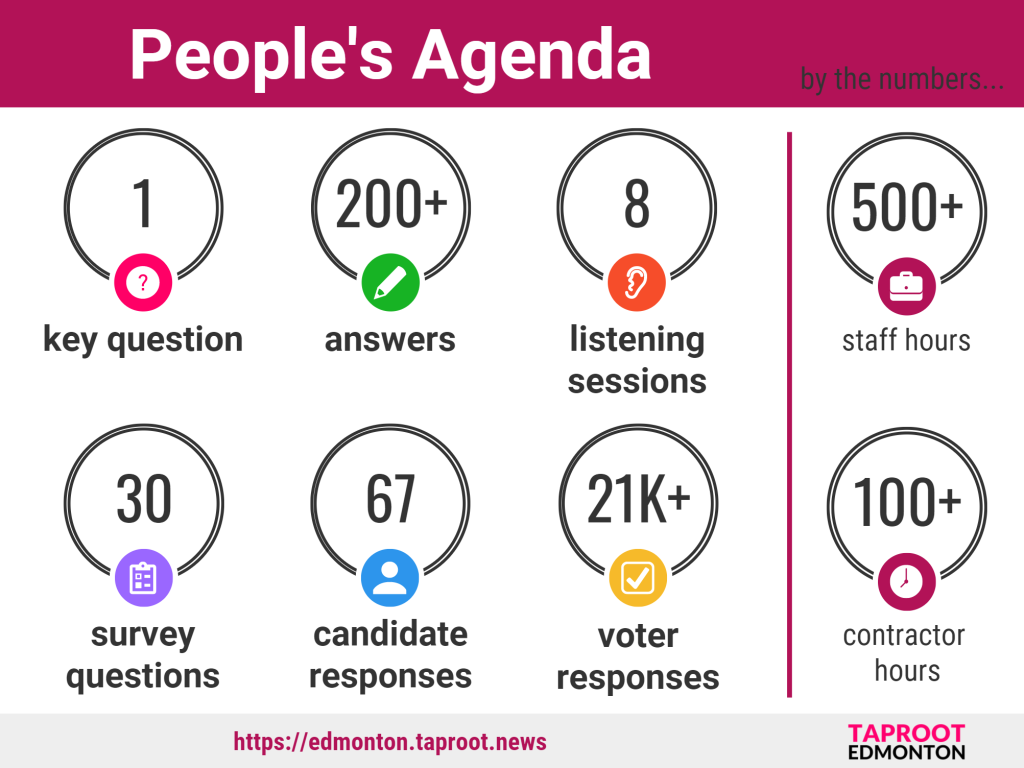
Some of the key facts and figures for the People’s Agenda project.

Lessons and challenges

This project took at least 500 hours of staff time and another 100+ hours from paid contributors, in addition to the time spent by steering committee members Elise Stolte and Rob Houle, as well as volunteer facilitators at our listening sessions.

It was at times overwhelming, but part of what made it so was not quite knowing where we were headed. There was a bit of wheel-spinning after our listening sessions, for example, when it wasn’t at all clear what our tiny team was going to be able to do with all of this input. The breakthrough was coming across The City’s Meet Your Mayor app, which inspired our own version.

It’s also worth noting that our startup changed significantly during the course of this project. In the summer of 2020, when we started the Election SOS training, our journalistic output consisted of several weekly newsletters on specific topics, a weekly podcast, and semi-regular stories that we shared on social media but didn’t have a very accessible home on our website.

In January 2021, we launched The Pulse, a weekday newsletter focused more generally on what goes on in our city. We had also revamped our home page to better display our journalism. That was vital to ensuring the project had impact. But The Pulse and the People’s Agenda weren’t as integrated as they could have been. Future engagement efforts will have to be fully part of what we do instead of happening in parallel as this project sometimes did.

While all of this was happening, we were also developing and delivering on the business-to-business product that helps to fund all of this work. That was vital, too, for while the project did sell some more memberships and increased our readership, which helps sell sponsorships and advertising, it did not pay for itself. Our model is such that the journalism is subsidized by the B2B side of our operation, and the growth we achieved earlier this year certainly made such an ambitious project possible. It would be fair to say, however, that the effort to bring the project to a strong conclusion ate into the time that we intended to put into business development in the last quarter.

We are coming out of this project with a reusable matching engine that we intend to employ not only for the next municipal election in 2025 but also in the interim, perhaps for elections at other levels or as a regular check-in on the current council. It may even be a product we could sell to others.

We have also developed a bit of a listening methodology that we’ll be able to streamline for future elections as well as ongoing check-ins on what matters to our community and what people want to better understand. We’re working on what that looks like. What we know for sure is that democracy is not just for election time, and neither is engaged, community-focused journalism. The People’s Agenda has taught us a lot about that. We’re eager to continue to apply those lessons as we go on.

What’s next

We encourage you to subscribe to The Pulse. You’ll receive our ongoing coverage of Edmonton and you’ll be among the first to participate in any new engagement opportunities. If you’d like to help ensure this work remains free for everyone, become a member.

If you’d like to know more about how we inform and connect communities, get in touch. We’d love to serve your community through our B2B offerings.

Finally, if you run a digital news site, work in journalism, or simply have ideas for how to make use of our matching engine, we’d love to hear from you.

By the numbers

  • 1 key question
  • 204 answers
  • 8 listening sessions
  • 10 topics
  • 30 survey questions
  • 67 candidate responses
  • 21,000+ voter responses
  • 500+ hours of staff time
  • 100+ hours of paid contributor time

Taproot does some more pruning

Taproot Edmonton is publishing the final edition of the Media Roundup on Feb. 15. From time-to-time you’ll still find coverage of media in Edmonton in The Pulse and on our website.

The evolution of the Media Roundup

We launched the Media Roundup in July 2018 to cover media, public relations, and communications in Edmonton.

I had been writing a blog series called Media Monday Edmonton since early 2011 and it made sense to bring that into Taproot when we started developing our roundups. We expanded the purview of the roundup and added events and job opportunities.

In June 2019, Linda Hoang came on board to take over the Media Roundup and she did a great job. But with her own growing online empire, Linda decided to step away and wrote her final edition last month.

Photo by Mark Tegethoff on Unsplash

Why are we making this change?

Linda’s departure accelerated discussions we were already having about how the Media Roundup fits into what we’re building with Taproot Edmonton.

We continue to strive for "less but better" and just as with the end of the Council Roundup, we think this change will help us focus on other efforts, such as The Pulse.

There’s a popular quote in writing circles that "you must kill your darlings." Originally attributed to William Faulkner and popularized by Stephen King, the phrase refers to characters, paragraphs, chapters, or other bits of writing that we’re fond of and want to keep, even if they get in the way of serving the reader.

It has been ten years since I posted the first entry in Media Monday Edmonton. Paying attention to and writing about the media so regularly definitely factored into the creation of Taproot. I’m grateful for that, and I’m ready to let it go.

What’s next?

As appropriate, we’ll include media and communications-related items in The Pulse, the Arts Roundup, Business Roundup, and other publications so please continue to send us your suggestions and tips.

We are always open to opportunities to better serve our community and welcome your feedback.

And if you haven’t already done so, sign up to get The Pulse for free!

Community-driven, audience-funded journalism at NASH81

Last week I had the opportunity to speak at NASH81: Refine, the annual gathering of Canada’s student journalists. This year’s event was hosted by the University of Calgary’s independent student publication The Gauntlet. Organizers put together an exciting schedule with talks on podcasting, visual storytelling, beatwriting, ethics, humour writing, freelancing, photojournalism, and much more.

I participated in a panel discussion that explored the question, is the future of journalism crowd-funded and community-driven? Joining me on the panel were Erin Millar, CEO of The Discourse, and Jeremy Klazsus, founder of The Sprawl. Our moderator was Katrina Ingram, strategic advisor at the Alberta Podcast Network and host of the Back to School Again podcast.

While there are some differences between our organizations, there are far more similarities. Each publication is pursuing an audience-pay model in which a significant proportion of revenue comes directly from members or patrons. The idea is to serve readers rather than advertisers, which the panel agreed is more likely to result in high quality journalism that is better aligned with what the community wants.

Another similarity is that content is accessible to everyone – you won’t find any paywalls here! The panel identified two key drivers behind this. The first is that for a story to have an impact, it needs to be widely consumed. Artificial barriers that get in the way of accessing content hinder our ability to make a difference in the communities we serve. The second is that supporters want our journalism to be available to those who can’t afford it and they’re happy to contribute toward making that possible.

Engagement is also critical to each of our organizations. We seek input from our community to help drive our journalism forward and to make sure we’re adding value with everything we do. The Discourse has a survey they ask members to take upon joining, The Sprawl actively solicits input via social media, and of course at Taproot we have the Story Garden. Everyone on the panel talked about the importance of listening.

We also discussed:

  • The importance of confronting inequity in journalism and how we must seek to avoid recreating legacy media’s lack of diversity
  • How the audience-pay model is built on trust which means sponsored content is a poor fit
  • That in serving our paying audience we tend not to chase the news of the day and instead practice what The Sprawl calls “slow journalism”
  • While the federal government’s funding announcement may have some positive impacts, there’s a risk it will simply prop up the legacy players rather than support badly needed innovation in Canadian media

As is the case with these sorts of discussions, there wasn’t enough time to say everything! The students in attendance asked great questions and I hope they found our approach to the future of journalism informative and inspiring.

For more on the topics we discussed, read “The rise of audience-funded journalism in Canada“, a report published by The Discourse in December 2018 with contributions from The Sprawl, Taproot Edmonton, and other digital independent news outlets across the country.

Help us do better beat reporting in Edmonton

Two weeks ago we published our latest story, a look at EEDC’s proposed Innovation Hub. Written by Eliza Barlow and edited by Therese Kehler, the story was well-received and widely read. Last week, City Council voted to request that EEDC pause work on the project, pending further review and engagement.

We first shared news of the Innovation Hub in an edition of the Tech Roundup in August, not long after we began work on the story. It takes time and effort to do the quality of journalism we strive for, and we wanted to make sure it would have an impact when we published it, so we set Edmonton Startup Week as the deadline. We got lucky that innovation was on the agenda at City Council to start the week too! We followed the story up with an episode of Speaking Municipally in which Troy Pavlek and I spoke with Eliza and Therese in more depth about the story and how they did their reporting. I also live-tweeted City Council meetings on October 15 and on October 23 where the Innovation Hub and related reports were discussed. We did a follow-up in Episode 12 of Speaking Municipally, and this week’s edition of the Tech Roundup. We’ve been on the case for a while, and will continue to provide updates through the Tech Roundup and future stories as appropriate.

We didn’t stumble into the story by accident, nor did we get lucky in the timing of its publication. Both were made possible because of the attention we pay to the tech beat here in Edmonton. We launched the Tech Roundup in early June, and already it has become the must-read publication for anyone interested in Edmonton’s technology sector. Every week we curate the latest local tech headlines & happenings, and that focused attention, alongside engagement with our community, allowed us to recognize there was a potential story on the horizon. It also gave us visibility into when Edmonton Startup Week was happening and when the topic of innovation was scheduled to be discussed by City Council.

We think beat reporting, especially local beat reporting, is critical.

Having fewer reporters on beats leads to “shallower stories, and a public with a shallower understanding of important issues and institutions,” Toronto Star reporter Daniel Dale told the Ryerson Review of Journalism in 2013. But in the nearly five years since that article was published things have gotten worse, not better. More than 250 Canadian news outlets have closed since 2008, and countless others have slashed the number of reporters they employ. According to the Canadian Media Guild‘s tracking of layoffs and buyouts for the past few decades, “the total is in the order of 12,000 positions lost.”

The reduction in stories being told reflects this, and it’s newsroom beats that have declined the most. According to the Public Policy Forum, the number of newspaper articles produced over the last 10 years has shrunk by almost half. Their report suggests that newsrooms may be “concentrating limited resources on covering civic affairs at the expense of other topics.”

The shrinking coverage of other topics is alarming and we’re working hard to do something about it.

Our work on the Innovation Hub story is illustrative of what we can do, even with limited resources. We’re optimistic about the future and the great local storytelling we’ll produce. But we need your help to do it. To be clear, we’re not a charity, and we’re not looking for a handout. We’re focused on delivering value to you, and we’re asking for you to invest in us so we can do even more great work. We hope you’ll join us.

Use the code INNOVATION before November 30 and save 10% on your first year of membership!