The Taproot Edmonton Calendar gets a major update

When we launched the Taproot Edmonton Calendar, we did it because we kept hearing the same thing over and over: it’s surprisingly hard to find out what’s going on in time to actually take part.

Since then, the calendar has grown into a core part of what Taproot Edmonton does. It powers event listings in The Pulse, the Events Roundup, and our other newsletters, it helps people plan their evenings and weekends, and we regularly hear from readers that it has become one of their favourite things we offer.

In November we launched a major update to the calendar that incorporates feedback from users, improves the user experience, and provides a stronger foundation for future enhancements.

What’s new in this release

This update is a long overdue refresh that brings the calendar in line with our news and vote sites, and adds a number of features that make it easier to find what you’re looking for. We have officially taken the calendar out of beta!

A cleaner, more cohesive design

The calendar now shares the same header and navigation structure as our news and election sites, so moving between them feels more seamless. It should be easier to jump from reading the latest news to finding upcoming events in the calendar.

We’ve also reduced duplication on the front page so you are more likely to see a wide variety of events at a glance, rather than the same listings repeated in multiple sections.

Multiple ways to view events

Everyone browses events a little differently, so we’ve added a layout toolbar to every page that lists events. You can now choose:

  • Cards: the visual layout you’re used to, with images.
  • Compact cards: a more streamlined view without images.
  • Table: a spreadsheet-style view that’s great for scanning dates, times, and locations quickly.
  • List: a simple, text-forward presentation.

Pick the layout that works best for you; the calendar will remember your choice, and you can change it any time with a click.

Search and better filtering

You can now search the calendar from the box at the top of every page, or use the dedicated search page to dig deeper. Today’s search is a straightforward keyword match on event titles, organizers, and locations, with some helpful shortcuts like “start:today” to zero in on what’s happening right now.

We’ve also expanded the filter options so you can narrow things down by criteria such as time of day, alongside the categories, dates, and locations that were already available. This should make it easier to find, say, family-friendly events on Saturday afternoons, or talks and panels after work.

Behind-the-scenes improvements

We have also made several technical improvements that will help us keep the calendar running smoothly as it continues to grow. These include:

  • Better handling of images to improve reliability and speed.
  • Spam filtering to reduce the number of inappropriate events submitted.

Why this matters to us (and, we hope, to you)

The Taproot Edmonton Calendar is not a side project. It is one of the most important ways we help the Edmonton region understand itself better.

Events are where ideas are shared, relationships are built, and communities take shape. A well-curated, reliable events calendar is part of the connective tissue that helps our community function. That’s why we’re continuing to invest in it.

How you can help the calendar grow

Here are some ways you can support and benefit from the Taproot Edmonton Calendar:

  • Use the calendar: Visit edmonton.taproot.events when you’re planning your week, or when someone asks, “What’s going on in Edmonton?”
  • Submit your events: If you host events in the Edmonton region, please submit them to the calendar. It is free and easy to do, and helps more people find out about what you’re doing.
  • Share it: Tell your friends, colleagues, and communities about the calendar and our Events Roundup newsletter so more people can discover what’s happening.
  • Support our work: If you’re in a position to do so, becoming a Taproot member helps sustain the calendar and all the other work we do to keep our community informed and connected.

What’s next?

We have several additional improvements to the calendar in the works, including:

  • Personalization options for Taproot members, such as saving events to a personal calendar.
  • Enhanced search and filtering capabilities, especially related to geography.
  • More ways to browse related events, such as guides for specific interests or themes.

We’re also excited about better integrating the calendar with our news site, to provide a more holistic view of what’s happening in the Edmonton region.

If you have feedback, spot a bug, or have an idea for how the Taproot Edmonton Calendar could serve you better, please get in touch.

That’s a wrap on Taproot’s 2025 election project

Just as we did four years ago, it’s time to put a bow on our election project. Over the past year, the entire Taproot team has worked diligently to provide Edmonton voters with reliable intelligence about the candidates running for office in the 2025 municipal election.

Core to this effort was the Taproot Survey, a questionnaire designed to surface how the candidates running for mayor and city council in Edmonton align with voters on the issues. In the end, 74 candidates running for mayor and city council completed the survey, and more than 27,000 people answered the same survey to see how the candidates aligned with their views.

The survey itself was informed by the 950+ responses to our election question, insights gathered at listening sessions, input from our election partners, and our own observations of what Edmonton’s next city council will face. You can learn more about how we crafted the survey in our previous blog post.

In addition to the Taproot Survey, we hosted several listening sessions, built a robust election website, partnered on a mayoral forum, published dozens of articles to help voters get ready for election day, and much more.

Projects like this are a big undertaking for a small but mighty team like ours. So, in this post, we want to take a moment to reflect on what we set out to do, what we built, the impact we had, and what’s next.

Why we did this

Our mission is to help communities understand themselves better, and this election project was a great opportunity to do just that.

Curiosity is at the heart of everything Taproot does, and covering a municipal election is no different. Our approach is to ground our work in the issues voters care about, rather than engaging in the “horse race” coverage that is more interested in who’s leading in the polls and other tendencies that reduce politics to a kind of sport.

We believe that communities work best when trustworthy information is available to everyone. We provide that to our community on a regular basis, and we hoped the election project would introduce Taproot to new audiences who might benefit from our work. Early indicators suggest we succeeded in that regard, with thousands of new readers engaging with our election coverage.

Of course, while our work is free to read it is not free to make, and we’re grateful to the hundreds of Taproot members whose financial support made this project possible. If you value work like this, please consider becoming a Taproot member.

Taproot co-founder Karen Unland shared closing remarks at the mayoral forum Taproot co-hosted with the Edmonton Public Library on Oct. 9, 2025. (Colin Gallant)

What we built

The entire project began with an expression of curiosity: What issues do you care about as you consider who to vote for in the 2025 municipal election, and why?. We gathered more than 950 responses to that question, a critical foundation for the rest of our work.

In May and June, we hosted five listening sessions to dive deeper into the issues we heard about. Dozens of Edmontonians shared their time and thoughts with us online and in person, and we learned a lot.

One of the new initiatives we launched this time around was our partner program, where we collaborated with organizations to integrate their communities into the process and help amplify our election work. We were thrilled to work with 32 organizations! Each partner could choose how much or little they wanted to be involved, from sharing the election question and Taproot Survey with their networks to co-hosting events. We learned a lot that will help us improve the program for future elections, and we’re grateful for the enthusiasm and support we received from our partners.

Input from the election question responses, listening sessions, and our partners helped us craft the Taproot Survey over the summer. Distilling all of that rich input into 30 multiple-choice questions was a challenge, but we’re proud of the final product. We also spent the summer months making several improvements to the software code that powers the survey, implementing new features such as the ability for candidates to add comments alongside their multiple-choice selections.

In early September, declared candidates for mayor and city council in Edmonton were invited to complete the survey. After nomination day on Sept. 22, we invited all registered candidates, and later that week we made the survey available to voters.

By the time Election Day arrived on Oct. 20, 74 candidates had completed the survey, and more than 27,000 voters had used it to see how they aligned with the candidates.

Here are some of the other key components we built as part of this project:

The impact we had

We’ve been thrilled with the response to our election project from voters, candidates, and partners alike. We’ve received many messages of thanks and appreciation for the work we’ve done, and it’s clear that our efforts have made a difference in helping people get informed and engaged in the election process.

That said, we recognize that the low voter turnout in this election — just 30.4% of eligible voters cast a ballot — is a disappointment. While our project likely helped many voters make informed choices, it’s clear that more work is needed to boost civic engagement.

Recently, we sent post-election surveys to voters, candidates, and partners to gather feedback on our election project. Here are some of the highlights from the responses we received (published with permission).

Voters

“Patty and I have been regular daily readers of Taproot since we moved to Edmonton,” David Blatt wrote. “Their coverage is always useful and comprehensive, but they did an especially magnificent job with the muncipal election, where they distributed a lengthy and thoughtful questionnaire to all mayoral and council candidates, along with a public survey, and then ran dozens of stories addressing all the major issues. They’re a great addition to the local news landscape and providing real benefit to Edmontonians new and old.”

“Taproot’s coverage of the election was unprecedented. No other organization has analyzed candidate views in this detailed way to help me make my voting choices,” Jim Stein told us.

“Taproot’s coverage of the election helped me understand the issues, evaluate candidates’ positions, and feel informed. The survey made me feel confident in my voting decisions,” Andrea Michaud told us.

“I have been recommending the Taproot election survey to anyone who will listen since the first time it was offered. It’s so useful to help get at the main issues that matter to me and how I align with the candidates. And if you haven’t been paying attention but you want to make an informed choice, it’s a great way to catch up with very little time and effort,” Kerry Powell told us.

“I really enjoyed Taproot’s election coverage, from the articles, the dashboard, and the podcast. It was a great way to stay informed about the election and gave me a great way to steer people who are less municipally inclined to get out and make an informed decision on their vote!” Bernardo R. told us.

“Great tool. Exciting to have a local, independent organization providing helpful, unbiased tools to help inform voters. Keep up the great work!” Cody Johnston told us.

Candidates

“Answering the Taproot candidate survey was an important step in my short campaign, as it helped me formulate or solidify my opinion on topics that I was aware of but hadn’t focused on during my campaign up to that point,” Jennifer Porritt, candidate for councillor in tastawiyiniwak, told us. “It gave me one of very few other forums to clearly articulate my position on a wide variety of topics that were important to voters.”

Partners

“I thought Taproot created a safe and inclusive space to participate in the conversation around election issues,” Nathan Binnema of Green Drinks YEG told us.

“Taproot’s election project gave so many in our communities access to resources and tools to help them with being informed as they headed into election season and to the polls,” Saniya Ghalehdar of She Said told us. “The Taproot team is responsive, engaged, and they truly care about informing and equipping voters. As a community member doing equity work, I feel that they were an integral part of helping build more inclusive and equitable resources for folks wanting to take part in democratic activities.”

What’s next

Our election project may be wrapping up, but our work is far from over.

We have several updates planned for our election website, including adding official election results by voting station, and adding final campaign finance disclosures when they become available in March 2026. Our team is still publishing articles related to the election, such as a recap of the swearing-in ceremony, and interviews with scrutineers about their experiences during the vote count.

But most of our attention will now turn to our regular coverage of city council. The “On the Agenda” feature, published every Monday when council is in session, provides an overview of upcoming council meetings and agenda items. Speaking Municipally, published every Friday, will continue to provide analysis and commentary about council’s decisions, and The Pulse provides the latest headlines, including those about city hall, every weekday morning.

If you value work like our election project, please become a Taproot member. There are many benefits of paid membership at the individual or organization level.

If you’re not ready to commit to membership but want to keep up-to-date on our work, subscribe to our newsletter.

By the numbers

  • 1 key question
  • 955 answers
  • 5 listening sessions
  • 30 survey questions
  • 74 candidate responses
  • 27,000+ voter responses

The Taproot Survey is helping voters and candidates ahead of Election Day

As we head into the final few days of the election, we want to share a few updates on our election project. If you’re still trying to decide who to vote for, we recommend taking the Taproot Survey to see which candidates align best with your views.

We have received several messages of gratitude for the Taproot Survey in recent weeks. Thanks to everyone who has reached out to us! Here are just a few of the comments we’ve received from voters:

  • “It is so helpful for citizens who want to become informed on the elections.”
  • “I came to realize how complex all the issues facing potential city councillors and potential mayors were.”
  • “It’s really a great way to filter out the people you’d actually vote for.”
  • “It was super easy and kinda fun.”

We have also heard from several candidates, who offered their thanks for the opportunity to share their views with voters. One candidate told us, “It’s an excellent way to help get Edmontonians engaged and strengthen our local democracy!”

More than 15,000 people have taken the survey so far, and we now have responses from 73 candidates, including all 13 mayoral candidates.

Please share the survey with your friends, family, and colleagues. A short link you can use is taproot.vote/match.

Recent updates

We have made several important updates to our election website since our last blog post:

  • Financial disclosures filed by candidates have been integrated into the website. You’ll find links on each candidate’s profile page, and we have a new page listing all the disclosures that were filed by the Sept. 30 deadline. We also wrote a story summarizing what we learned from the disclosures.
  • You can now more easily compare how candidates responded to the Taproot Survey. Each candidate’s profile page includes a Compare button that lets you select up to three candidates to compare side-by-side. For example, here’s a comparison of mayoral candidates Tim Cartmell, Rahim Jaffer, Andrew Knack, and Michael Walters.
  • Some candidates wanted to make changes to their survey responses, perhaps to fix typos or to provide answers to questions they might have skipped originally. All such changes are now reflected on the site and clearly marked as updated. The new Updates page puts them all in one place for additional transparency.
  • We have incorporated survey responses into the affiliation pages, so you can now see how candidates from each party responded to the survey in one place. Here are the pages for Better Edmonton and PACE.
  • There’s a new page listing all of the pitches that candidates submitted along with their survey responses.
  • We’ve made several updates to candidate profiles, including new photos and social links. Thanks to everyone who sent us updated information.

Voters and candidates on the issues

In addition to the Taproot survey, our team has been busy covering the election in other ways. You can find all our election coverage tagged #yegvote. A few highlights:

Mayoral forum recap

In partnership with the Edmonton Public Library, we hosted a forum with 10 of the 13 mayoral candidates on Oct. 9. Stacey Brotzel moderated the event, which featured questions from our team and the audience.

You can watch the full recording on YouTube. We also wrote a story about what we heard from the candidates regarding infrastructure, property taxes, and infill. I also spoke about the forum during my latest segment for CBC’s Edmonton AM.

What’s next

Monday, Oct. 20 is election day, and the polls will be open from 9am to 8pm. If you’re unsure where to vote, you can use our Election Guide to find your voting station, or check out the City of Edmonton’s voter information page.

We have updated our election website with a results dashboard that will go live as soon as the polls close. We expect to receive some results on election night, but we don’t expect to know who will form the next city council until some time on Tuesday, Oct. 21. We’ll share what we know on our website and in The Pulse.

Next week’s episode of Speaking Municipally will dive into the election results. Taproot members can join us for a special edition of Taproot Exchange on Friday, Oct. 24 at 12pm where we’ll discuss what the results mean for Edmonton’s next city council. Watch your inbox for the link to join us.

Consider becoming a member

It takes a lot of work to undertake a project like this, and we couldn’t do it without the support of our members. If you value this work, please consider becoming a Taproot member. Membership is just $10/month or $100/year for individuals. If your organization would like to support our work and benefit from reliable intelligence about the Edmonton region, we also have an organizational membership option.

Take the Taproot Survey to see how the candidates align with you

We’re excited to launch our tool that helps you find out how the candidates running for mayor and city council in Edmonton align with you on the issues that matter most.

Take the same survey the candidates did, and see to what extent they share your views and priorities: taproot.vote/match.

This “voter matching engine,” as we’ve called it in some places, is accompanied by a robust voter guide, all motivated by our mission to help you make informed choices in the 2025 municipal election.

How it works

The Taproot Survey is a 30-question, multiple-choice questionnaire covering a wide range of topics relevant to Edmonton’s next city council. It was informed by the 900+ responses to our election question, insights gathered at listening sessions, input from our election partners, and our own observations of what Edmonton’s next city council will face. You can learn more about how we crafted the survey in our previous blog post.

To start, pick the ward you live in (our integrated lookup tool will help you find it), and then answer the same questions the candidates did. Each question has three possible responses. You can also choose to skip questions.

When you complete the survey, the tool compares your answers to those of the candidates who have responded so far. It then shows you which candidates align most closely with your views and priorities.

The first thing you’ll see is the “Alignment overview” table, which you can filter by mayoral and council candidates. The table shows how many questions you and each candidate answered the same way, and it gives you a percentage score, too.

This sample shows results for a voter in Ward papastew, filtered to show only councillor candidates.

It is very unlikely that you’ll find a candidate who matches you 100%, so we encourage you to spend some time with the results.

Keep scrolling down and you’ll see the “Alignment by question” section, which lists every question you answered and shows which candidates agreed with you on each one. This way, you can also zero in on where the candidates stand on the issues that you consider crucial.

What else you can do

You’ll find a lot of links to click on throughout the tool. Here are some highlights:

  • If you click on the links in the “Agreement on” column, which shows the number of questions you and each candidate agreed on, you’ll see a head-to-head comparison of your answers and theirs (you can also access this using the “By candidate” dropdown at the top of the page).
  • Each question is hyperlinked to a page that shows you how every candidate responded to it.
  • Each candidate’s name is hyperlinked to their profile page, which includes their survey responses (including any additional comments they might have made), contact information, and a pitch to voters if they provided one.
  • Each ward name is hyperlinked to a page that lists all the candidates running in that ward and includes their survey responses.

The results page also includes a “Share your results” section with buttons that let you share your matches on social media or copy a link to send. We don’t store any personal information about you, so you can share your results without worrying about your privacy.

Much more to explore

Our revamped election website, edmonton.taproot.vote, has a lot more to explore:

You’ll also find the latest coverage from our team. Over the next few weeks, we’ll be rolling out more features and content to help you get ready for election day on Oct. 20.

If you value this work, please become a Taproot member. We recently updated our website to better highlight the benefits of paid membership at the individual or organization level.

If you’re not ready to commit to membership but want to keep up-to-date on our election work, subscribe to our newsletter.

Candidates can now answer Taproot Edmonton’s election survey

When we first shared our election project back in March, we included a rough timeline of what to expect in the months and days leading up to the Oct. 20 municipal election. I’m happy to report that we have mostly stuck to that schedule!

Candidate survey sent, responses coming in

The latest milestone was the completion of our candidate survey, which we began sending on Sept. 6 to those running for election.

If you’re running for mayor or city council in Edmonton, you should have received an email with a link to the survey. If you haven’t, please get in touch with us at hello@taprootedmonton.ca.

The survey includes 30 questions covering a wide range of topics. It was informed by the 900+ responses to our election question, insights gathered at listening sessions, input from our election partners, and our own observations of what Edmonton’s next city council will face.

This year’s survey is an evolution of the one we developed for the 2021 municipal election, incorporating best practices and lessons learned. For example, we kept the multiple choice format, but added an optional text box for candidates to provide additional information for each question.

Last time we had 10 categories or topics with three questions each. This time, while we grouped related questions together to make completing the survey easier, we do not have a fixed number of questions per category. When drafting the survey, we organized questions into three big types. Many questions ask about a candidate’s views, some address their priorities, and some ask about action they would take. Each type of question has similar wording.

The questions are designed to be clear, concise, and easy to answer. Like last time, each question is accompanied by some brief context crafted by our editorial team to help candidates and voters better understand the issue at hand.

Every question this time has just three possible responses, plus a standard “I don’t have a position on this issue” option. Candidates can also choose to skip questions. We did our best to craft responses that will meaningfully differentiate candidates.

Everyone who filled out the 2021 survey saw the questions and responses in the same order. This time around, we are randomizing the groupings of questions and the order of responses within each question. This approach helps reduce bias.

It’s a lot of work to put together a survey like this! Our team spent many hours drafting, revising, and testing the survey to ensure it meets our expectations of clarity, fairness, and usefulness to voters.

The survey is an important step toward our goal of equipping voters with reliable, issue-focused information ahead of the election. Now we need candidates to complete it.

As of Sept. 12, we have 33 responses from candidates either completed or in progress. We are hoping to have collected most responses by Nomination Day on Sept. 22.

After that, we’ll launch our voter matching engine, which will enable voters to take the same survey to see how the candidates align with them on the issues. Thousands of Edmontonians used the tool in 2021 to help them make informed choices.

Candidates’ answers will also be displayed along with their other information on our election website, (as we did in 2021).

Taproot Edmonton is partnering with the Edmonton Public Library on its mayoral forum on Oct. 9, 2025. Learn more.

More opportunities to learn where candidates stand

Another place you’ll see the results of the survey is at the mayoral forum we have partnered with the Edmonton Public Library on, to be held at the Stanley A. Milner branch and online on the evening of Oct. 9. Some of the questions to be put to the candidates will be informed by the survey results. Register to attend, and watch the Taproot Edmonton Calendar for other opportunities to inform yourself ahead of the Oct. 20 election.

We’ll also be incorporating the survey results into our election coverage. Our journalists have already been digging into various election issues, often drawing on results of our listening work. For example, the team looked into tackling homelessness in Edmonton, a top concern for voters who participated in our listening sessions.

There’s much more to come in the weeks ahead!

If you value this work, become a Taproot member. We recently updated our website to better highlight the benefits of paid membership at the individual or organization level.

If you just want to keep up-to-date on our election work, please subscribe to our newsletter.

Housing Complex wins Collaboration of the Year award

We’re thrilled beyond measure to announce that Housing Complex was named the Collaboration of the Year in the small revenue tier at the 2025 LION Publishers Sustainability Awards, which were presented in St. Louis, MO, on Sept. 3.

Housing Complex, which was made possible with the help of the Edmonton Coalition on Housing and Homelessness, was named a Collaboration of the Year at the 2025 LION Awards. (Jordon Hon)

Taproot’s series on what works, what doesn’t, and what can be improved about Edmonton’s housing system was the result of a collaboration with the Edmonton Coalition on Housing and Homelessness. ECOHH helped us secure funding from the Alberta Real Estate Foundation, which made it possible for writer Eric Rice and photographer Jordon Hon to capture the stories of 12 people who play various roles in the housing system. Their careful and empathetic portraits were surrounded by explanatory pieces from Taproot’s editorial team, made up of managing editor Tim Querengesser and reporters Colin Gallant and Stephanie Swensrude; community coordinator Debbi Serafinchon organized the event we held to further engage with the themes explored in the series.

“Hands down, this is a tour de force of the power of collaboration and the power of serving your community with high-quality journalism delivered with care, respect, and depth,” one of the judges wrote. “It is deeply reported and heartfelt. One of the best examples of journalism I’ve experienced in a long time. Bravo.”

LION Publishers is an organization focused on helping local, independent, online news publications in the U.S. and Canada build more sustainable businesses. We’re proud to be among its 575+ members, and it means a lot to be recognized in this way. Congratulations to the other 20 award winners, including our fellow Canadians at La Converse, which won the Community Engagement Award in the small-revenue tier for a video series with residents of under-served communities in Montreal.

Next up is the 2025 municipal election

In some ways, Housing Complex set the table for our 2025 municipal election project, which we are now in the thick of. Many of the issues raised in our award-winning series came up in the 800+ responses to our election question, but of course, many other issues were raised as well.

Taking inspiration from those responses — as well as the further insights gathered at listening sessions, input from our election partners, and our own observations of what Edmonton’s next city council will face — we have put together a 30-question survey for candidates for mayor and city council. Those who have declared their intention to run will receive it soon, and we’ll make sure everyone who is running has the opportunity to respond shortly after nominations close on Sept. 22.

That same week, we will launch our voter matching engine, which will enable you to take the same survey to see how the candidates align with you on the issues that matter most to you. Thousands of Edmontonians used the tool in 2021, and we expect tens of thousands to do the same this time around.

Our journalists have already started digging into various election issues, often drawing on results of our listening work.

We are also excited to partner with the Edmonton Public Library on a mayoral forum, to be held at the Stanley A. Milner branch and online on the evening of Oct. 9. Register to attend, and watch the Taproot Edmonton Calendar for other opportunities to inform yourself ahead of the Oct. 20 election.

What we heard at our election listening sessions

Throughout May and June, we hosted five listening sessions dubbed “What’s on your mind, municipally speaking?” to hear from Edmontonians about the issues that matter most to them in the 2025 municipal election. Two of the sessions were online, and three were in person at Edmonton Public Library branches in Castle Downs, The Meadows, and downtown.

In 2021, pandemic restrictions meant every listening session we held happened on Zoom. This year, we could mix virtual and in-person events, and it was incredibly rewarding to meet people where they live.

The listening sessions are a key part of our 2025 municipal election project, which aims to help Edmontonians make informed choices in the upcoming election. The idea was to offer space for people to go a little deeper into the issues that matter most to them.

We are grateful to everyone who took the time to share their thoughts with us. We heard from dozens of people, and we learned a lot.

An excerpt from the flip-chart notes taken at our listening session in Castle Downs on June 7, 2025.

A flavour of what we heard

Hundreds of comments, whiteboard notes, and flip-chart scribbles coalesced into several clear themes, including homelessness, social disorder, governance and accountability, infill, housing affordability, infrastructure and growth, policing and public safety, active transportation, and climate change.

Here are some examples of what we heard:

  • “How we deal with the homeless population, how we view them, is kind of fundamental to how we view other aspects of our society.” Participants agreed that the housing crisis demands urgency, creativity, and empathy while also acknowledging growing unease about safety on transit and in public spaces.
  • “The city has done a lot of work around initiatives and reports and plans, and then there’s no accountability to actually deliver on those.” People want competence over theatrics: clearer measures of success, better follow-through on approved plans, and safeguards against party-style politics that could deepen polarization.
  • “What I am against is in older, mature neighbourhoods, where all of a sudden you’ve got house, house, house, 11-unit building right beside the house. No parking provided.” Support for compact growth collides with worries about lost trees, parking shortages, and oversized projects that feel out of scale. Residents asked how council will preserve neighbourhood character while meeting housing targets.
  • “We need to build deeply affordable housing, and we’re not doing it right now.” Beyond homelessness, people fear being priced out of the city altogether. They pressed for tools — like inclusionary zoning or city-owned land — to keep a mix of incomes in every ward.
  • “A lot of the business people … they’re just having to close because they can’t get people to their businesses. And I don’t know that the city is doing much to help them.” From LRT construction headaches to rec-centre shortages, voters questioned whether Edmonton is choosing the right projects, sequencing them well, and mitigating disruption for local businesses.
  • “I’m not saying defund the police. I’m just saying, can there be a reallocation into different agencies that would be better suited to provide the types of support that we’re looking for?” Many see value in policing but want a bigger share of the safety budget to flow to mental-health teams, outreach workers, and transit peace officers.
  • “Bike lanes are seen as anti-car, and I’d like to hear the rhetoric change to ‘transportation options.’” Debate over bike lanes remains fiery, yet there is a growing chorus for neighbourhoods where walking, rolling, and transit feel as convenient and as safe as driving.
  • “The smoke has been … like a hard punch, because it almost always comes.” Wildfire smoke, heat islands, and tree loss turned abstract climate goals into lived reality. Participants talked about tangible resilience measures, from shade infrastructure to tougher tree-retention rules, alongside emissions cuts.

Underlying many of these discussions is a frustration with the limits of municipal power when provincial decisions (or inaction) shape key files such as housing, policing, and social services.

How we analyzed the input

We used large-language-model tools at two key points. First, we fed the transcripts, flip-chart photos, and whiteboard notes into a large-language model and asked it to cluster recurring ideas. Those thematic groupings came straight from the AI; for the purposes of this post, we did not apply any editorial tweaks to that structure. Second, we asked the same model to pull candidate quotations for each theme. From the resulting pool, Taproot chose the excerpts you see here.

Looking ahead to the broader election project, we’ll run several rounds of analysis with multiple large-language models on all the input we collect. The goal is to get a comprehensive, data-driven view of community priorities; our editorial team will then combine those machine-generated insights with additional reporting and judgment to shape the candidate survey and other election tools.

We’re fortunate to have powerful large-language-model tools at our fingertips to handle the heavy lifting of pattern-spotting and quote-gathering, freeing our team to focus on other important work. Because this technology is evolving quickly, we’re committed to learning in public and following emerging best practices, including recommendations from resources like Trusting News, to keep our use of AI transparent, responsible, and firmly anchored in human editorial judgment.

What happens next

Alongside our election question, input gathered at these sessions will help us draft a candidate survey that will be sent to all candidates this summer. The survey will form the backbone of our voter matching engine, which we plan to launch in September.

Here’s what’s next in our election project timeline:

  • July and August: Formulate the candidate survey;
  • August and September: Distribute the survey to all declared candidates;
  • Sept. 22 to Oct. 20: Distribute the matching engine through Taproot’s channels and community partners;
  • Oct. 20: Election Day.

How you can still help

There’s still time for your input to shape our work! If you haven’t already, please take a moment to answer our election question: What issues do you care about as you consider who to vote for in the 2025 municipal election, and why?

Every response helps us build a better candidate survey and a more useful voter-matching tool, so Edmontonians can make confident, well-informed choices on Oct. 20.

If you’re an organization that wants to help spread the word and ensure your community’s perspective is considered, get in touch to become an election partner. We have 22 partners so far, and we’d love to work with you.

Housing Complex a finalist for Collaboration of the Year

We’re proud to announce that Housing Complex — Taproot’s series on what works, what doesn’t, and what can be improved about Edmonton’s housing system — has been named a finalist in the Collaboration of the Year category at the 2025 LION Publishers Sustainability Awards.

UPDATE: We won the award! Read more about that here.

Housing Complex, which was made possible through a collaboration with the Edmonton Coalition on Housing and Homelessness, is in the running for Collaboration of the Year at the upcoming LION Awards.

This series would not have been possible without the help of the Edmonton Coalition on Housing and Homelessness, nor would this nomination. The Collaboration of the Year award recognizes a local, independent, online news publisher that has “successfully formed a short-term or long-term collaboration with at least one other organization to positively affect their journalistic impact, financial health, and/or operational resilience.”

Partnering with ECOHH allowed Taproot to access funding from the Alberta Real Estate Foundation, making it possible to assign writer Eric Rice and photographer Jordon Hon to capture the stories of 12 people who play various roles in the housing system. Those portraits became the heart of a multi-part series surrounded by explanatory work from Taproot’s editorial team.

We also worked with ECOHH to secure more funds for a well-attended and interactive event to help people further engage with the topic. We are endlessly grateful to ECOHH’s Jim Gurnett for helping us find a way to pursue this project, which would otherwise have been beyond our means. And we are indebted to Eric for not only conducting these interviews with immense empathy and care, but also laying the groundwork to make this collaboration possible.

The awards will be presented on Sept. 3 in St. Louis, MO, during the Independent News Sustainability Summit. Many thanks to LION Publishers for this recognition, and good luck to all of the finalists. Your work is immensely inspiring.

Election brings opportunity for more collaboration

When we embarked on the project that became Housing Complex, we expected housing to be a key election issue, and that assumption has been borne out by the responses so far to our election question: What issues do you care about as you consider who to vote for in the 2025 municipal election, and why?. The answers to this question will inform the survey we’ll be sending to candidates later this summer, and that will form the basis of the voter matching engine that we’ll make available to everyone in the fall. So if you haven’t weighed in yet on the question, please do — the more people we hear from, the better.

We’re happy to have the participation of several election partners to help us increase the breadth and depth of this work. They are using their channels to spread the question, and they’ll continue to engage their communities leading up to the Oct. 20 vote. If you belong to an organization that should be involved, get in touch.

A progress report on Taproot’s election project

Much has happened since last we spoke about our election plan, so here’s an update on what we’ve done so far and what’s to come.

A tiny sample of what we heard at the May 22 listening session to dive deeper into the issues that matter heading into the municipal election. (Debbi Serafinchon)

Hundreds of answers to the election question

This entire project begins with an expression of curiosity: What issues do you care about as you consider who to vote for in the 2025 municipal election, and why?.

So far, we have collected more than 550 answers, which is about double what we gathered in 2021. That’s a tremendous start, but we’d love to gather even more. If you haven’t answered the question yet, please do, and spread it around to your friends and family.

Three listening sessions done, two to go

At a series of events dubbed “What’s on your mind, municipally speaking?”, we’ve had some wonderfully engaging conversations. Many thanks to those who joined us virtually on May 14 and in person on May 22 and June 7 to dive deeper into some of the issues that arose in the early responses to our question.

We have been so impressed by the thoughtful input offered, as well as the participants’ willingness to hear out people who have different points of view. We’ve learned a lot, and attendees seem happy to have spent the time.

You can still sign up for one of the two remaining sessions:

  • June 11 at 6:30pm online
  • June 14 at 2pm at The Meadows branch of the Edmonton Public Library

All attendees will receive a little something from our friends at Unbelts. Many thanks to the Edmonton Public Library for hosting our in-person sessions.

More than a dozen election partners signed

We’ve enlisted the help of several election partners to support our effort to equip voters to make confident, well-informed choices.

These organizations have agreed to spread our question, invite people to listening sessions, encourage candidates to fill out our survey, and circulate our voter matching engine. In return, they get a space on our election site to express what issues are important to them.

As of this writing, we have 13 election partners signed on:

We’re in talks with several others, but there’s room for more. If your organization should be on this list, get in touch.

What’s next

The answers to our election question, the input gathered at the listening sessions, and the issues surfaced by our election partners will inform the questions we ask in our candidate survey.

To help us make sense of this enormous pool of data, we’ll be employing AI (specifically, large-language models such as ChatGPT or Gemini). It is the nature of these tools to reflect the biases inherent in their training data — we’ll work hard to mitigate that as we derive the questions we’ll be putting to the candidates.

The questions will not capture every issue we hear about, nor will they necessarily reflect what we hear about most. Rather, the survey will be geared toward municipal issues on which candidates are likely to have differentiating opinions, expressed in multiple-choice answers. This is what we’ll need to build the voter matching engine, which will let you take the same survey and learn which candidates align with you best.

Declared candidates will receive their surveys starting in mid- to late August. We expect to learn about a few more when nominations close on Sept. 22, and we’ll get those candidates their surveys as soon as possible after that. Candidates’ answers will be displayed along with their other information on our election website, (as we did in 2021).

As soon as we have a critical mass of candidate responses, we’ll make the voter matching engine available to use until polls close on Oct. 20.

What you can do

While we’re in the information-gathering phase between now and early July, these are the things to do or spread the word about:

Once the candidate survey is ready to go in August, please encourage the candidates in your ward to fill it out. And watch for the voter matching engine in September.

We’re working with a partner to present a forum for mayoral candidates in Edmonton in the fall — we’ll share details as soon as they’re firmed up. If you are aware of any candidate forums or other related events, in Edmonton or the surrounding region, please submit them to the Taproot Edmonton Calendar.

Finally, if you value this work, become a Taproot member. You’ll be helping us inform, connect, and inspire the community.

What we learned about Taproot’s audience

In early 2025, we surveyed our audience to better understand who Taproot is serving. As we said at the time, we don’t track our readers the way social media platforms and many other websites do, so if we want to know more about you, we ask.

Before we get into the results, let me tell you: It’s lovely to have to ask. When Mack and I started this company in 2016, and for a few years after that, we literally knew most of the people on our mailing list. It wasn’t that challenging to speak with authority about who the typical Taproot reader was. But I’m proud to say we have grown far beyond our own pretty sizeable personal networks, and I don’t know most of the people who read Taproot anymore. That’s awesome.

Hundreds of people filled out the survey we sent in February. Here’s what we found out:

Taproot readers love local

Based on that aforementioned knowledge of Taproot’s early adopters, I have long said that Taproot readers tend to be the kind of people who seek out local goods and services — they know the benefits that come from investing in our own community. Now we have the numbers to back that up: Given a choice between a local product and a non-local one, 76% told our survey they would pay slightly more for the local product, and 15% said they would pay significantly more.

Further to that shop-local ethos, 82% said they had dined at a local restaurant in the past month, and 76% said they had bought something from a locally owned business within the same period.

Our readers are an artsy crew, too. In the previous six months:

  • 52% attended a concert;
  • 50% attended a play, musical, or opera;
  • 46% went to a museum, art gallery, or science centre;
  • 45% attended a festival.

These activities aren’t exclusively local, but where we live, they often are. Interestingly, in this hockey-mad city, only 29% of our respondents said they had attended a professional sports event in the past six months, and 13% said they had never done so.

Taproot readers are grateful to those who support our work

One of Taproot’s revenue streams is sponsorship and advertising, which is another reason we sent this survey. Companies with marketing budgets want to know who they will reach if they buy space in Taproot, and now we have better answers.

We also have evidence that Taproot readers feel warmly towards those who help make all of this information available to everyone. Almost three-quarters said they feel positively or very positively toward the sponsors whose logos appear in every edition of our weekly newsletters. And more than half said that if a company supports Taproot through sponsorship, advertising, or membership, they are more likely to consider their product/service for future purchases.

Taproot readers have deep roots in Edmonton

More than three-quarters of our respondents said they have lived in the Edmonton region for more than 20 years. This surprised me a little, given the population influx we’ve seen over the past few years, and it points to some room for improvement. Reading Taproot seems like a great way for newcomers to get a crash course on Edmonton. We’ve clearly got some work to do to increase awareness among recent arrivals.

Given those demographics, it’s perhaps not surprising that 79% own their own home, and 32% said their annual household income exceeds $150,000 a year. About two-thirds of our respondents are employed, and 26% are retired. They’re educated, too: 45% have an undergraduate degree, 30% have a graduate degree, and 16% have a college diploma or certificate.

Taproot makes a difference

We asked readers to indicate the degree to which they agreed with a series of statements, and the results were gratifying:

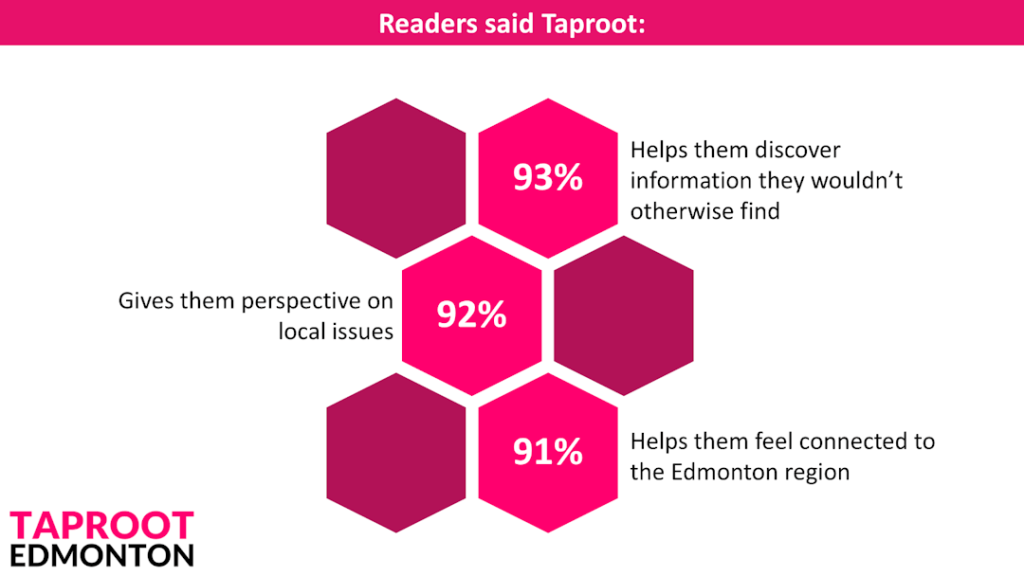
  • 95% said Taproot helps them be engaged citizens;
  • 87% said Taproot makes them think;
  • 87% said Taproot pays attention to things they care about;
  • 82% said Taproot gives them something to talk about;
  • 78% said Taproot provides information they can’t find elsewhere;
  • 77% said Taproot helps the Edmonton region work better;
  • 61% said Taproot saves them time.

That’s what we’re going for, so it’s good to see we’re succeeding in the minds of many readers. There’s some room for improvement here, too, which is helpful to identify.

The point of the survey was to up our quantitative game, but I’m going to conclude with some qualitative data. The survey included an open-ended question: “What else would you like us to know?” Here’s a small sample of what people said:

  • “I love Taproot, it has made me more engaged in the city I love. Thanks for all the wonderful work!”
  • “I am so grateful for the local, insightful coverage you provide of things happening in the city. Your city hall reporting is stellar and your support of local entrepreneurs, artists and social causes is the only way I keep in touch with what’s new and important to me. You help me stay connected, interested and engaged.”
  • “I love having the daily local perspective of Taproot. I feel like a part of my community.”
  • “So grateful Taproot exists so I can stay in the loop on everything Edmonton! Thank you for your engagement and effort.”
  • “I love Speaking Municipally and The Pulse… both make me feel much more connected to and aware of important things happening in the city. Thanks for all that you do.”
  • “I love this as a resource and I share it often, especially to peers and colleagues at work. It’s literally a great way to keep a ‘pulse’ on things without feeling draining. The focus on local news is refreshing and incredibly important.”

These comments are particularly loving, but we also heard about things we could do better, and that’s beneficial, too. Thanks to all who let us know more about who you are and what you care about.

One more thing

A few readers told us that as much as they love Taproot, they can’t afford to pay for a membership. “I really value Taproot and, when I make more money, I intend to support y’all financially,” said a student who responded to our survey. We heard similar sentiments when we asked about membership benefits in 2024.

If you can’t afford $100 a year or $10 a month for Taproot, that’s OK. We have no paywall on purpose. Our mission is to inform, connect, and inspire the Edmonton region, and making our work available only to those who pay would work against that. So don’t fret. You can help us in other ways:

  • Share our work.
  • Recommend Taproot to a friend. There’s a referral link at the top of every email we send.
  • Encourage your employer to buy ads or an organization-wide membership.
  • Let our sponsors and advertisers know you appreciate their support.

If you can afford to pay for a Taproot membership, please do. Our work is free to read, but it’s not free to make, and we all benefit from a more informed, connected, and inspired community.

Paid members get other benefits, too. Members recently got a chance to win tickets to a concert, and there are more perks in the works. But the main thing is that you’ll be helping that student know what’s going on, even though they can’t spare the cash quite yet. And your money stays here in Edmonton, making it possible for us to keep doing what we do.