A progress report on Taproot’s election project

Much has happened since last we spoke about our election plan, so here’s an update on what we’ve done so far and what’s to come.

A tiny sample of what we heard at the May 22 listening session to dive deeper into the issues that matter heading into the municipal election. (Debbi Serafinchon)

Hundreds of answers to the election question

This entire project begins with an expression of curiosity: What issues do you care about as you consider who to vote for in the 2025 municipal election, and why?.

So far, we have collected more than 550 answers, which is about double what we gathered in 2021. That’s a tremendous start, but we’d love to gather even more. If you haven’t answered the question yet, please do, and spread it around to your friends and family.

Three listening sessions done, two to go

At a series of events dubbed “What’s on your mind, municipally speaking?”, we’ve had some wonderfully engaging conversations. Many thanks to those who joined us virtually on May 14 and in person on May 22 and June 7 to dive deeper into some of the issues that arose in the early responses to our question.

We have been so impressed by the thoughtful input offered, as well as the participants’ willingness to hear out people who have different points of view. We’ve learned a lot, and attendees seem happy to have spent the time.

You can still sign up for one of the two remaining sessions:

  • June 11 at 6:30pm online
  • June 14 at 2pm at The Meadows branch of the Edmonton Public Library

All attendees will receive a little something from our friends at Unbelts. Many thanks to the Edmonton Public Library for hosting our in-person sessions.

More than a dozen election partners signed

We’ve enlisted the help of several election partners to support our effort to equip voters to make confident, well-informed choices.

These organizations have agreed to spread our question, invite people to listening sessions, encourage candidates to fill out our survey, and circulate our voter matching engine. In return, they get a space on our election site to express what issues are important to them.

As of this writing, we have 13 election partners signed on:

We’re in talks with several others, but there’s room for more. If your organization should be on this list, get in touch.

What’s next

The answers to our election question, the input gathered at the listening sessions, and the issues surfaced by our election partners will inform the questions we ask in our candidate survey.

To help us make sense of this enormous pool of data, we’ll be employing AI (specifically, large-language models such as ChatGPT or Gemini). It is the nature of these tools to reflect the biases inherent in their training data — we’ll work hard to mitigate that as we derive the questions we’ll be putting to the candidates.

The questions will not capture every issue we hear about, nor will they necessarily reflect what we hear about most. Rather, the survey will be geared toward municipal issues on which candidates are likely to have differentiating opinions, expressed in multiple-choice answers. This is what we’ll need to build the voter matching engine, which will let you take the same survey and learn which candidates align with you best.

Declared candidates will receive their surveys starting in mid- to late August. We expect to learn about a few more when nominations close on Sept. 22, and we’ll get those candidates their surveys as soon as possible after that. Candidates’ answers will be displayed along with their other information on our election website, (as we did in 2021).

As soon as we have a critical mass of candidate responses, we’ll make the voter matching engine available to use until polls close on Oct. 20.

What you can do

While we’re in the information-gathering phase between now and early July, these are the things to do or spread the word about:

Once the candidate survey is ready to go in August, please encourage the candidates in your ward to fill it out. And watch for the voter matching engine in September.

We’re working with a partner to present a forum for mayoral candidates in Edmonton in the fall — we’ll share details as soon as they’re firmed up. If you are aware of any candidate forums or other related events, in Edmonton or the surrounding region, please submit them to the Taproot Edmonton Calendar.

Finally, if you value this work, become a Taproot member. You’ll be helping us inform, connect, and inspire the community.

It’s time to share what’s on your election agenda

Curiosity is at the heart of everything Taproot does, and covering a municipal election is no different. Our approach is not to tell you what we think, nor is it to concentrate on what the candidates promise. We begin by asking what you care about and building our work around that in the months leading up to voting day on Oct. 20.

A placard under the Taproot Edmonton logo with the question "What do municipal candidates need to know about housing in Edmonton?" with index cards on which people have answered that question
We started gathering input during our housing event in November 2024 — now we’re widening the aperture with a bigger question about what’s on your mind heading into the 2025 municipal election. (Flickr/Mack Male)

If you were reading Taproot in 2021, you may remember this approach as the People’s Agenda. We called it that because we drew inspiration from Jay Rosen’s concept of the Citizens Agenda. This method gives journalists a way to ground their work in the issues voters care about, rather than engaging in the “horse race” coverage that is more interested in who’s leading in the polls and other tendencies that reduce politics to a kind of sport.

When we embarked on that project during the last election campaign, we weren’t sure what we would end up with. We just knew we wanted to listen to the people and equip them to make informed decisions. In the end, we figured out a way to be useful to thousands of voters, and we’re ready to do it again, in a bigger and better way, employing the lessons of 2021.

What do we want to know?

Here’s this election’s kickoff question: What issues do you care about as you consider who to vote for in the 2025 municipal election, and why?. It’s an open-ended question meant to capture not only what’s on your mind but also what you want to hear about from the candidates for mayor and council as they compete for your vote. You might want to keep in mind the kinds of issues that are under municipal jurisdiction as opposed to provincial or federal — the City of Spruce Grove has a handy guide — but don’t get too tangled up in that. Speak from your heart.

This year, we are also inviting (but not requiring) you to share the first three characters in your postal code. That’s so we can see if there are any discernible patterns in what matters to people in particular wards in Edmonton or specific municipalities in the metro region.

What will we do with the answers?

The responses will be one of the most important inputs for the Taproot Survey, which we will distribute to candidates so they can indicate where they stand on the issues that are important to you. In 2021, we asked 30 multiple-choice questions reflecting the topics raised in our information-gathering. Some were very specific, such as “Do you think city council should have approved the Epcor’s E.L. Smith Solar Farm?” Others were more general, such as “How much should the city spend to help local business recover from the pandemic?”

Some candidates did not like the multiple-choice format, and to be sure, political questions tend to have nuances that are difficult to capture in four or five standardized responses. But this format makes it possible to let voters take the same survey and find out which candidates they align with. This matching engine turned out to be a powerful way to equip voters with actionable information. It was also a great (and free) way for candidates to make their positions known and find their voters, in a way that can’t be touched by how much money they have raised. We intend to make the matching engine available again.

In 2021, we also synthesized the responses to the initial question into eight sub-questions, such as “Will our taxes be well-spent?” or “Will we act on climate change?” Each of these was the inspiration for an online listening session that yielded Taproot stories and more information to inform the questions in our candidate survey. We have something similar in mind for this campaign as well.

Making sense of all of the information we gathered in 2021 was a challenge given the tools at our disposal. Taproot’s reach has grown significantly since then, and we expect the number of answers we gather will be an order of magnitude greater than what we managed last time. Luckily, we can now harness the power of generative AI to sift through the pile of data and help us understand what’s on people’s minds. No identifying information will be used for this analysis, and humans will oversee every step. But we’re excited to see how quickly we’ll be able to gain understanding with this help. We may also use AI to help us craft the wording of the multiple-choice questions to ensure the answers provide as much clarity on a candidate’s stance as possible.

How are we involving community partners?

This work derives some of its authority from the depth and breadth of the information we gather. We want to hear not only from Taproot’s community but also from those who are outside our orbit, to ensure a large, diverse pool of knowledge. We’ll be working with community partners to get our initial question out to their communities. We’ll also be asking them to encourage candidates to answer the survey and to distribute our matching engine when it’s ready for voters to use.

To help fund the significant amount of work that this entire election project will entail, we will be offering partners the opportunity to pay for access to some of the data we gather. This data will be anonymized and in line with our privacy policy. These paying partners will not have any say over the questions we ask or the way we cover the election; they will simply have access to deeper information than that which we will display to the public. These partners will be listed on Taproot’s election site.

What happens next?

Here’s the timeline we have in mind:

  • March to May: Gather answers to the election question through Taproot’s channels and with the help of community partners;
  • May and June: Hold listening sessions to dive deeper into some of the issues surfaced;
  • July and August: Formulate the candidate survey;
  • August and September: Distribute the survey to all declared candidates;
  • Sept. 22 to Oct. 20: Distribute the matching engine through Taproot’s channels and community partners;
  • Oct. 20: Election Day

Throughout this period, Taproot’s editorial team will continue to publish election-related stories, leaning towards the kind of explanatory work they did as part of the Housing Complex project. Story ideas and pitches can be sent to hello@taprootedmonton.ca. We’d also like to list election forums and related events in the Taproot Edmonton Calendar. Here’s the submission page.

Our election site will have a full listing of every candidate for mayor, councillor, public school trustee, or Catholic school trustee in Edmonton, with links to their websites. We may do the same for candidates in some of the municipalities in the metro region — we’re looking into how much more complexity that may introduce, and will be guided in part by the amount of participation we see from voters in the region.

Given the province’s decision to ban automated vote tabulators, we expect we won’t be able to provide the same kind of real-time results dashboard we’ve made available in previous elections. But we will display the results and the stances of the winning candidates once we know them.

How can you help?

The first thing to do is to answer the question. Once again, here it is: What issues do you care about as you consider who to vote for in the 2025 municipal election, and why?.

Please spread that link to friends, family, and colleagues. The more people we hear from, the better. If you are part of an organization that would like to help us distribute the question, please get in touch with Mack at mack@taprootpublishing.ca.

You’ll notice the question page invites you to opt in to receive email from us, as a subscriber to Taproot in general and/or to receive alerts about the readiness of the matching engine and other election tools. This is optional, and your email address will not be correlated in any way with your answers. We do hope you’ll consider signing up if you’re not already on Taproot’s mailing list.

Finally, as you can well imagine, it’s expensive to do this kind of work. Becoming a paying member of Taproot, either as an individual or as an organization, provides us with vital resources to pay the people who pay attention to the Edmonton region, not only at election time but year-round.

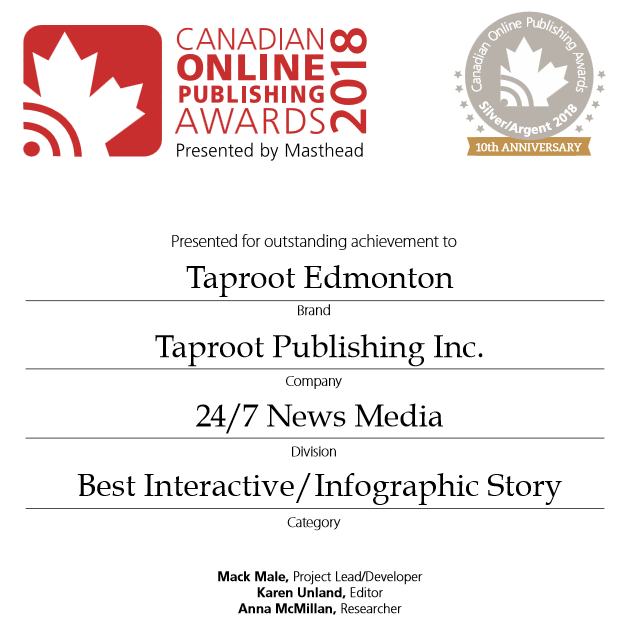
Silver for our election microsite at the 2018 COPAs

The 2018 Canadian Online Publishing Awards were handed out last week and Taproot Edmonton is thrilled to share that we won Silver in the Best Interactive/Infographic Story category for our 2017 Municipal Election microsite.

Martin Seto, producer of the COPAs, said they “celebrate the people that produce content in a world where there is growing mistrust of the media and the widespread distribution of tabloid and farticle content on the internet.” This year was the 10th anniversary of the awards.

We combined open data from the City with other data that we collected to build the election microsite. Prior to Election Day, readers could use the Election Guide to find their wards, candidates, voting station, and more simply by entering their address or clicking the “Locate Me” button. On Election Night, the results dashboard provided real-time updates on every race, total voter turnout, and other interesting data points, such as the incumbents being defeated and the most supported candidates. Once the information became available, we updated the microsite with campaign finance disclosures. You can easily search the data to see all the donations that candidates received.

The microsite was built by Mack Male, with editing from Karen Unland and research by Anna McMillan.

Read more about our microsite and companion email newsletter.