That’s a wrap on Taproot’s 2025 election project

Just as we did four years ago, it’s time to put a bow on our election project. Over the past year, the entire Taproot team has worked diligently to provide Edmonton voters with reliable intelligence about the candidates running for office in the 2025 municipal election.

Core to this effort was the Taproot Survey, a questionnaire designed to surface how the candidates running for mayor and city council in Edmonton align with voters on the issues. In the end, 74 candidates running for mayor and city council completed the survey, and more than 27,000 people answered the same survey to see how the candidates aligned with their views.

The survey itself was informed by the 950+ responses to our election question, insights gathered at listening sessions, input from our election partners, and our own observations of what Edmonton’s next city council will face. You can learn more about how we crafted the survey in our previous blog post.

In addition to the Taproot Survey, we hosted several listening sessions, built a robust election website, partnered on a mayoral forum, published dozens of articles to help voters get ready for election day, and much more.

Projects like this are a big undertaking for a small but mighty team like ours. So, in this post, we want to take a moment to reflect on what we set out to do, what we built, the impact we had, and what’s next.

Why we did this

Our mission is to help communities understand themselves better, and this election project was a great opportunity to do just that.

Curiosity is at the heart of everything Taproot does, and covering a municipal election is no different. Our approach is to ground our work in the issues voters care about, rather than engaging in the “horse race” coverage that is more interested in who’s leading in the polls and other tendencies that reduce politics to a kind of sport.

We believe that communities work best when trustworthy information is available to everyone. We provide that to our community on a regular basis, and we hoped the election project would introduce Taproot to new audiences who might benefit from our work. Early indicators suggest we succeeded in that regard, with thousands of new readers engaging with our election coverage.

Of course, while our work is free to read it is not free to make, and we’re grateful to the hundreds of Taproot members whose financial support made this project possible. If you value work like this, please consider becoming a Taproot member.

Taproot co-founder Karen Unland shared closing remarks at the mayoral forum Taproot co-hosted with the Edmonton Public Library on Oct. 9, 2025. (Colin Gallant)

What we built

The entire project began with an expression of curiosity: What issues do you care about as you consider who to vote for in the 2025 municipal election, and why?. We gathered more than 950 responses to that question, a critical foundation for the rest of our work.

In May and June, we hosted five listening sessions to dive deeper into the issues we heard about. Dozens of Edmontonians shared their time and thoughts with us online and in person, and we learned a lot.

One of the new initiatives we launched this time around was our partner program, where we collaborated with organizations to integrate their communities into the process and help amplify our election work. We were thrilled to work with 32 organizations! Each partner could choose how much or little they wanted to be involved, from sharing the election question and Taproot Survey with their networks to co-hosting events. We learned a lot that will help us improve the program for future elections, and we’re grateful for the enthusiasm and support we received from our partners.

Input from the election question responses, listening sessions, and our partners helped us craft the Taproot Survey over the summer. Distilling all of that rich input into 30 multiple-choice questions was a challenge, but we’re proud of the final product. We also spent the summer months making several improvements to the software code that powers the survey, implementing new features such as the ability for candidates to add comments alongside their multiple-choice selections.

In early September, declared candidates for mayor and city council in Edmonton were invited to complete the survey. After nomination day on Sept. 22, we invited all registered candidates, and later that week we made the survey available to voters.

By the time Election Day arrived on Oct. 20, 74 candidates had completed the survey, and more than 27,000 voters had used it to see how they aligned with the candidates.

Here are some of the other key components we built as part of this project:

The impact we had

We’ve been thrilled with the response to our election project from voters, candidates, and partners alike. We’ve received many messages of thanks and appreciation for the work we’ve done, and it’s clear that our efforts have made a difference in helping people get informed and engaged in the election process.

That said, we recognize that the low voter turnout in this election — just 30.4% of eligible voters cast a ballot — is a disappointment. While our project likely helped many voters make informed choices, it’s clear that more work is needed to boost civic engagement.

Recently, we sent post-election surveys to voters, candidates, and partners to gather feedback on our election project. Here are some of the highlights from the responses we received (published with permission).

Voters

“Patty and I have been regular daily readers of Taproot since we moved to Edmonton,” David Blatt wrote. “Their coverage is always useful and comprehensive, but they did an especially magnificent job with the muncipal election, where they distributed a lengthy and thoughtful questionnaire to all mayoral and council candidates, along with a public survey, and then ran dozens of stories addressing all the major issues. They’re a great addition to the local news landscape and providing real benefit to Edmontonians new and old.”

“Taproot’s coverage of the election was unprecedented. No other organization has analyzed candidate views in this detailed way to help me make my voting choices,” Jim Stein told us.

“Taproot’s coverage of the election helped me understand the issues, evaluate candidates’ positions, and feel informed. The survey made me feel confident in my voting decisions,” Andrea Michaud told us.

“I have been recommending the Taproot election survey to anyone who will listen since the first time it was offered. It’s so useful to help get at the main issues that matter to me and how I align with the candidates. And if you haven’t been paying attention but you want to make an informed choice, it’s a great way to catch up with very little time and effort,” Kerry Powell told us.

“I really enjoyed Taproot’s election coverage, from the articles, the dashboard, and the podcast. It was a great way to stay informed about the election and gave me a great way to steer people who are less municipally inclined to get out and make an informed decision on their vote!” Bernardo R. told us.

“Great tool. Exciting to have a local, independent organization providing helpful, unbiased tools to help inform voters. Keep up the great work!” Cody Johnston told us.

Candidates

“Answering the Taproot candidate survey was an important step in my short campaign, as it helped me formulate or solidify my opinion on topics that I was aware of but hadn’t focused on during my campaign up to that point,” Jennifer Porritt, candidate for councillor in tastawiyiniwak, told us. “It gave me one of very few other forums to clearly articulate my position on a wide variety of topics that were important to voters.”

Partners

“I thought Taproot created a safe and inclusive space to participate in the conversation around election issues,” Nathan Binnema of Green Drinks YEG told us.

“Taproot’s election project gave so many in our communities access to resources and tools to help them with being informed as they headed into election season and to the polls,” Saniya Ghalehdar of She Said told us. “The Taproot team is responsive, engaged, and they truly care about informing and equipping voters. As a community member doing equity work, I feel that they were an integral part of helping build more inclusive and equitable resources for folks wanting to take part in democratic activities.”

What’s next

Our election project may be wrapping up, but our work is far from over.

We have several updates planned for our election website, including adding official election results by voting station, and adding final campaign finance disclosures when they become available in March 2026. Our team is still publishing articles related to the election, such as a recap of the swearing-in ceremony, and interviews with scrutineers about their experiences during the vote count.

But most of our attention will now turn to our regular coverage of city council. The “On the Agenda” feature, published every Monday when council is in session, provides an overview of upcoming council meetings and agenda items. Speaking Municipally, published every Friday, will continue to provide analysis and commentary about council’s decisions, and The Pulse provides the latest headlines, including those about city hall, every weekday morning.

If you value work like our election project, please become a Taproot member. There are many benefits of paid membership at the individual or organization level.

If you’re not ready to commit to membership but want to keep up-to-date on our work, subscribe to our newsletter.

By the numbers

  • 1 key question
  • 955 answers
  • 5 listening sessions
  • 30 survey questions
  • 74 candidate responses
  • 27,000+ voter responses

The Taproot Survey is helping voters and candidates ahead of Election Day

As we head into the final few days of the election, we want to share a few updates on our election project. If you’re still trying to decide who to vote for, we recommend taking the Taproot Survey to see which candidates align best with your views.

We have received several messages of gratitude for the Taproot Survey in recent weeks. Thanks to everyone who has reached out to us! Here are just a few of the comments we’ve received from voters:

  • “It is so helpful for citizens who want to become informed on the elections.”
  • “I came to realize how complex all the issues facing potential city councillors and potential mayors were.”
  • “It’s really a great way to filter out the people you’d actually vote for.”
  • “It was super easy and kinda fun.”

We have also heard from several candidates, who offered their thanks for the opportunity to share their views with voters. One candidate told us, “It’s an excellent way to help get Edmontonians engaged and strengthen our local democracy!”

More than 15,000 people have taken the survey so far, and we now have responses from 73 candidates, including all 13 mayoral candidates.

Please share the survey with your friends, family, and colleagues. A short link you can use is taproot.vote/match.

Recent updates

We have made several important updates to our election website since our last blog post:

  • Financial disclosures filed by candidates have been integrated into the website. You’ll find links on each candidate’s profile page, and we have a new page listing all the disclosures that were filed by the Sept. 30 deadline. We also wrote a story summarizing what we learned from the disclosures.
  • You can now more easily compare how candidates responded to the Taproot Survey. Each candidate’s profile page includes a Compare button that lets you select up to three candidates to compare side-by-side. For example, here’s a comparison of mayoral candidates Tim Cartmell, Rahim Jaffer, Andrew Knack, and Michael Walters.
  • Some candidates wanted to make changes to their survey responses, perhaps to fix typos or to provide answers to questions they might have skipped originally. All such changes are now reflected on the site and clearly marked as updated. The new Updates page puts them all in one place for additional transparency.
  • We have incorporated survey responses into the affiliation pages, so you can now see how candidates from each party responded to the survey in one place. Here are the pages for Better Edmonton and PACE.
  • There’s a new page listing all of the pitches that candidates submitted along with their survey responses.
  • We’ve made several updates to candidate profiles, including new photos and social links. Thanks to everyone who sent us updated information.

Voters and candidates on the issues

In addition to the Taproot survey, our team has been busy covering the election in other ways. You can find all our election coverage tagged #yegvote. A few highlights:

Mayoral forum recap

In partnership with the Edmonton Public Library, we hosted a forum with 10 of the 13 mayoral candidates on Oct. 9. Stacey Brotzel moderated the event, which featured questions from our team and the audience.

You can watch the full recording on YouTube. We also wrote a story about what we heard from the candidates regarding infrastructure, property taxes, and infill. I also spoke about the forum during my latest segment for CBC’s Edmonton AM.

What’s next

Monday, Oct. 20 is election day, and the polls will be open from 9am to 8pm. If you’re unsure where to vote, you can use our Election Guide to find your voting station, or check out the City of Edmonton’s voter information page.

We have updated our election website with a results dashboard that will go live as soon as the polls close. We expect to receive some results on election night, but we don’t expect to know who will form the next city council until some time on Tuesday, Oct. 21. We’ll share what we know on our website and in The Pulse.

Next week’s episode of Speaking Municipally will dive into the election results. Taproot members can join us for a special edition of Taproot Exchange on Friday, Oct. 24 at 12pm where we’ll discuss what the results mean for Edmonton’s next city council. Watch your inbox for the link to join us.

Consider becoming a member

It takes a lot of work to undertake a project like this, and we couldn’t do it without the support of our members. If you value this work, please consider becoming a Taproot member. Membership is just $10/month or $100/year for individuals. If your organization would like to support our work and benefit from reliable intelligence about the Edmonton region, we also have an organizational membership option.

Take the Taproot Survey to see how the candidates align with you

We’re excited to launch our tool that helps you find out how the candidates running for mayor and city council in Edmonton align with you on the issues that matter most.

Take the same survey the candidates did, and see to what extent they share your views and priorities: taproot.vote/match.

This “voter matching engine,” as we’ve called it in some places, is accompanied by a robust voter guide, all motivated by our mission to help you make informed choices in the 2025 municipal election.

How it works

The Taproot Survey is a 30-question, multiple-choice questionnaire covering a wide range of topics relevant to Edmonton’s next city council. It was informed by the 900+ responses to our election question, insights gathered at listening sessions, input from our election partners, and our own observations of what Edmonton’s next city council will face. You can learn more about how we crafted the survey in our previous blog post.

To start, pick the ward you live in (our integrated lookup tool will help you find it), and then answer the same questions the candidates did. Each question has three possible responses. You can also choose to skip questions.

When you complete the survey, the tool compares your answers to those of the candidates who have responded so far. It then shows you which candidates align most closely with your views and priorities.

The first thing you’ll see is the “Alignment overview” table, which you can filter by mayoral and council candidates. The table shows how many questions you and each candidate answered the same way, and it gives you a percentage score, too.

This sample shows results for a voter in Ward papastew, filtered to show only councillor candidates.

It is very unlikely that you’ll find a candidate who matches you 100%, so we encourage you to spend some time with the results.

Keep scrolling down and you’ll see the “Alignment by question” section, which lists every question you answered and shows which candidates agreed with you on each one. This way, you can also zero in on where the candidates stand on the issues that you consider crucial.

What else you can do

You’ll find a lot of links to click on throughout the tool. Here are some highlights:

  • If you click on the links in the “Agreement on” column, which shows the number of questions you and each candidate agreed on, you’ll see a head-to-head comparison of your answers and theirs (you can also access this using the “By candidate” dropdown at the top of the page).
  • Each question is hyperlinked to a page that shows you how every candidate responded to it.
  • Each candidate’s name is hyperlinked to their profile page, which includes their survey responses (including any additional comments they might have made), contact information, and a pitch to voters if they provided one.
  • Each ward name is hyperlinked to a page that lists all the candidates running in that ward and includes their survey responses.

The results page also includes a “Share your results” section with buttons that let you share your matches on social media or copy a link to send. We don’t store any personal information about you, so you can share your results without worrying about your privacy.

Much more to explore

Our revamped election website, edmonton.taproot.vote, has a lot more to explore:

You’ll also find the latest coverage from our team. Over the next few weeks, we’ll be rolling out more features and content to help you get ready for election day on Oct. 20.

If you value this work, please become a Taproot member. We recently updated our website to better highlight the benefits of paid membership at the individual or organization level.

If you’re not ready to commit to membership but want to keep up-to-date on our election work, subscribe to our newsletter.

Candidates can now answer Taproot Edmonton’s election survey

When we first shared our election project back in March, we included a rough timeline of what to expect in the months and days leading up to the Oct. 20 municipal election. I’m happy to report that we have mostly stuck to that schedule!

Candidate survey sent, responses coming in

The latest milestone was the completion of our candidate survey, which we began sending on Sept. 6 to those running for election.

If you’re running for mayor or city council in Edmonton, you should have received an email with a link to the survey. If you haven’t, please get in touch with us at hello@taprootedmonton.ca.

The survey includes 30 questions covering a wide range of topics. It was informed by the 900+ responses to our election question, insights gathered at listening sessions, input from our election partners, and our own observations of what Edmonton’s next city council will face.

This year’s survey is an evolution of the one we developed for the 2021 municipal election, incorporating best practices and lessons learned. For example, we kept the multiple choice format, but added an optional text box for candidates to provide additional information for each question.

Last time we had 10 categories or topics with three questions each. This time, while we grouped related questions together to make completing the survey easier, we do not have a fixed number of questions per category. When drafting the survey, we organized questions into three big types. Many questions ask about a candidate’s views, some address their priorities, and some ask about action they would take. Each type of question has similar wording.

The questions are designed to be clear, concise, and easy to answer. Like last time, each question is accompanied by some brief context crafted by our editorial team to help candidates and voters better understand the issue at hand.

Every question this time has just three possible responses, plus a standard “I don’t have a position on this issue” option. Candidates can also choose to skip questions. We did our best to craft responses that will meaningfully differentiate candidates.

Everyone who filled out the 2021 survey saw the questions and responses in the same order. This time around, we are randomizing the groupings of questions and the order of responses within each question. This approach helps reduce bias.

It’s a lot of work to put together a survey like this! Our team spent many hours drafting, revising, and testing the survey to ensure it meets our expectations of clarity, fairness, and usefulness to voters.

The survey is an important step toward our goal of equipping voters with reliable, issue-focused information ahead of the election. Now we need candidates to complete it.

As of Sept. 12, we have 33 responses from candidates either completed or in progress. We are hoping to have collected most responses by Nomination Day on Sept. 22.

After that, we’ll launch our voter matching engine, which will enable voters to take the same survey to see how the candidates align with them on the issues. Thousands of Edmontonians used the tool in 2021 to help them make informed choices.

Candidates’ answers will also be displayed along with their other information on our election website, (as we did in 2021).

Taproot Edmonton is partnering with the Edmonton Public Library on its mayoral forum on Oct. 9, 2025. Learn more.

More opportunities to learn where candidates stand

Another place you’ll see the results of the survey is at the mayoral forum we have partnered with the Edmonton Public Library on, to be held at the Stanley A. Milner branch and online on the evening of Oct. 9. Some of the questions to be put to the candidates will be informed by the survey results. Register to attend, and watch the Taproot Edmonton Calendar for other opportunities to inform yourself ahead of the Oct. 20 election.

We’ll also be incorporating the survey results into our election coverage. Our journalists have already been digging into various election issues, often drawing on results of our listening work. For example, the team looked into tackling homelessness in Edmonton, a top concern for voters who participated in our listening sessions.

There’s much more to come in the weeks ahead!

If you value this work, become a Taproot member. We recently updated our website to better highlight the benefits of paid membership at the individual or organization level.

If you just want to keep up-to-date on our election work, please subscribe to our newsletter.

What we heard at our election listening sessions

Throughout May and June, we hosted five listening sessions dubbed “What’s on your mind, municipally speaking?” to hear from Edmontonians about the issues that matter most to them in the 2025 municipal election. Two of the sessions were online, and three were in person at Edmonton Public Library branches in Castle Downs, The Meadows, and downtown.

In 2021, pandemic restrictions meant every listening session we held happened on Zoom. This year, we could mix virtual and in-person events, and it was incredibly rewarding to meet people where they live.

The listening sessions are a key part of our 2025 municipal election project, which aims to help Edmontonians make informed choices in the upcoming election. The idea was to offer space for people to go a little deeper into the issues that matter most to them.

We are grateful to everyone who took the time to share their thoughts with us. We heard from dozens of people, and we learned a lot.

An excerpt from the flip-chart notes taken at our listening session in Castle Downs on June 7, 2025.

A flavour of what we heard

Hundreds of comments, whiteboard notes, and flip-chart scribbles coalesced into several clear themes, including homelessness, social disorder, governance and accountability, infill, housing affordability, infrastructure and growth, policing and public safety, active transportation, and climate change.

Here are some examples of what we heard:

  • “How we deal with the homeless population, how we view them, is kind of fundamental to how we view other aspects of our society.” Participants agreed that the housing crisis demands urgency, creativity, and empathy while also acknowledging growing unease about safety on transit and in public spaces.
  • “The city has done a lot of work around initiatives and reports and plans, and then there’s no accountability to actually deliver on those.” People want competence over theatrics: clearer measures of success, better follow-through on approved plans, and safeguards against party-style politics that could deepen polarization.
  • “What I am against is in older, mature neighbourhoods, where all of a sudden you’ve got house, house, house, 11-unit building right beside the house. No parking provided.” Support for compact growth collides with worries about lost trees, parking shortages, and oversized projects that feel out of scale. Residents asked how council will preserve neighbourhood character while meeting housing targets.
  • “We need to build deeply affordable housing, and we’re not doing it right now.” Beyond homelessness, people fear being priced out of the city altogether. They pressed for tools — like inclusionary zoning or city-owned land — to keep a mix of incomes in every ward.
  • “A lot of the business people … they’re just having to close because they can’t get people to their businesses. And I don’t know that the city is doing much to help them.” From LRT construction headaches to rec-centre shortages, voters questioned whether Edmonton is choosing the right projects, sequencing them well, and mitigating disruption for local businesses.
  • “I’m not saying defund the police. I’m just saying, can there be a reallocation into different agencies that would be better suited to provide the types of support that we’re looking for?” Many see value in policing but want a bigger share of the safety budget to flow to mental-health teams, outreach workers, and transit peace officers.
  • “Bike lanes are seen as anti-car, and I’d like to hear the rhetoric change to ‘transportation options.’” Debate over bike lanes remains fiery, yet there is a growing chorus for neighbourhoods where walking, rolling, and transit feel as convenient and as safe as driving.
  • “The smoke has been … like a hard punch, because it almost always comes.” Wildfire smoke, heat islands, and tree loss turned abstract climate goals into lived reality. Participants talked about tangible resilience measures, from shade infrastructure to tougher tree-retention rules, alongside emissions cuts.

Underlying many of these discussions is a frustration with the limits of municipal power when provincial decisions (or inaction) shape key files such as housing, policing, and social services.

How we analyzed the input

We used large-language-model tools at two key points. First, we fed the transcripts, flip-chart photos, and whiteboard notes into a large-language model and asked it to cluster recurring ideas. Those thematic groupings came straight from the AI; for the purposes of this post, we did not apply any editorial tweaks to that structure. Second, we asked the same model to pull candidate quotations for each theme. From the resulting pool, Taproot chose the excerpts you see here.

Looking ahead to the broader election project, we’ll run several rounds of analysis with multiple large-language models on all the input we collect. The goal is to get a comprehensive, data-driven view of community priorities; our editorial team will then combine those machine-generated insights with additional reporting and judgment to shape the candidate survey and other election tools.

We’re fortunate to have powerful large-language-model tools at our fingertips to handle the heavy lifting of pattern-spotting and quote-gathering, freeing our team to focus on other important work. Because this technology is evolving quickly, we’re committed to learning in public and following emerging best practices, including recommendations from resources like Trusting News, to keep our use of AI transparent, responsible, and firmly anchored in human editorial judgment.

What happens next

Alongside our election question, input gathered at these sessions will help us draft a candidate survey that will be sent to all candidates this summer. The survey will form the backbone of our voter matching engine, which we plan to launch in September.

Here’s what’s next in our election project timeline:

  • July and August: Formulate the candidate survey;
  • August and September: Distribute the survey to all declared candidates;
  • Sept. 22 to Oct. 20: Distribute the matching engine through Taproot’s channels and community partners;
  • Oct. 20: Election Day.

How you can still help

There’s still time for your input to shape our work! If you haven’t already, please take a moment to answer our election question: What issues do you care about as you consider who to vote for in the 2025 municipal election, and why?

Every response helps us build a better candidate survey and a more useful voter-matching tool, so Edmontonians can make confident, well-informed choices on Oct. 20.

If you’re an organization that wants to help spread the word and ensure your community’s perspective is considered, get in touch to become an election partner. We have 22 partners so far, and we’d love to work with you.

A progress report on Taproot’s election project

Much has happened since last we spoke about our election plan, so here’s an update on what we’ve done so far and what’s to come.

A tiny sample of what we heard at the May 22 listening session to dive deeper into the issues that matter heading into the municipal election. (Debbi Serafinchon)

Hundreds of answers to the election question

This entire project begins with an expression of curiosity: What issues do you care about as you consider who to vote for in the 2025 municipal election, and why?.

So far, we have collected more than 550 answers, which is about double what we gathered in 2021. That’s a tremendous start, but we’d love to gather even more. If you haven’t answered the question yet, please do, and spread it around to your friends and family.

Three listening sessions done, two to go

At a series of events dubbed “What’s on your mind, municipally speaking?”, we’ve had some wonderfully engaging conversations. Many thanks to those who joined us virtually on May 14 and in person on May 22 and June 7 to dive deeper into some of the issues that arose in the early responses to our question.

We have been so impressed by the thoughtful input offered, as well as the participants’ willingness to hear out people who have different points of view. We’ve learned a lot, and attendees seem happy to have spent the time.

You can still sign up for one of the two remaining sessions:

  • June 11 at 6:30pm online
  • June 14 at 2pm at The Meadows branch of the Edmonton Public Library

All attendees will receive a little something from our friends at Unbelts. Many thanks to the Edmonton Public Library for hosting our in-person sessions.

More than a dozen election partners signed

We’ve enlisted the help of several election partners to support our effort to equip voters to make confident, well-informed choices.

These organizations have agreed to spread our question, invite people to listening sessions, encourage candidates to fill out our survey, and circulate our voter matching engine. In return, they get a space on our election site to express what issues are important to them.

As of this writing, we have 13 election partners signed on:

We’re in talks with several others, but there’s room for more. If your organization should be on this list, get in touch.

What’s next

The answers to our election question, the input gathered at the listening sessions, and the issues surfaced by our election partners will inform the questions we ask in our candidate survey.

To help us make sense of this enormous pool of data, we’ll be employing AI (specifically, large-language models such as ChatGPT or Gemini). It is the nature of these tools to reflect the biases inherent in their training data — we’ll work hard to mitigate that as we derive the questions we’ll be putting to the candidates.

The questions will not capture every issue we hear about, nor will they necessarily reflect what we hear about most. Rather, the survey will be geared toward municipal issues on which candidates are likely to have differentiating opinions, expressed in multiple-choice answers. This is what we’ll need to build the voter matching engine, which will let you take the same survey and learn which candidates align with you best.

Declared candidates will receive their surveys starting in mid- to late August. We expect to learn about a few more when nominations close on Sept. 22, and we’ll get those candidates their surveys as soon as possible after that. Candidates’ answers will be displayed along with their other information on our election website, (as we did in 2021).

As soon as we have a critical mass of candidate responses, we’ll make the voter matching engine available to use until polls close on Oct. 20.

What you can do

While we’re in the information-gathering phase between now and early July, these are the things to do or spread the word about:

Once the candidate survey is ready to go in August, please encourage the candidates in your ward to fill it out. And watch for the voter matching engine in September.

We’re working with a partner to present a forum for mayoral candidates in Edmonton in the fall — we’ll share details as soon as they’re firmed up. If you are aware of any candidate forums or other related events, in Edmonton or the surrounding region, please submit them to the Taproot Edmonton Calendar.

Finally, if you value this work, become a Taproot member. You’ll be helping us inform, connect, and inspire the community.

It’s time to share what’s on your election agenda

Curiosity is at the heart of everything Taproot does, and covering a municipal election is no different. Our approach is not to tell you what we think, nor is it to concentrate on what the candidates promise. We begin by asking what you care about and building our work around that in the months leading up to voting day on Oct. 20.

A placard under the Taproot Edmonton logo with the question "What do municipal candidates need to know about housing in Edmonton?" with index cards on which people have answered that question
We started gathering input during our housing event in November 2024 — now we’re widening the aperture with a bigger question about what’s on your mind heading into the 2025 municipal election. (Flickr/Mack Male)

If you were reading Taproot in 2021, you may remember this approach as the People’s Agenda. We called it that because we drew inspiration from Jay Rosen’s concept of the Citizens Agenda. This method gives journalists a way to ground their work in the issues voters care about, rather than engaging in the “horse race” coverage that is more interested in who’s leading in the polls and other tendencies that reduce politics to a kind of sport.

When we embarked on that project during the last election campaign, we weren’t sure what we would end up with. We just knew we wanted to listen to the people and equip them to make informed decisions. In the end, we figured out a way to be useful to thousands of voters, and we’re ready to do it again, in a bigger and better way, employing the lessons of 2021.

What do we want to know?

Here’s this election’s kickoff question: What issues do you care about as you consider who to vote for in the 2025 municipal election, and why?. It’s an open-ended question meant to capture not only what’s on your mind but also what you want to hear about from the candidates for mayor and council as they compete for your vote. You might want to keep in mind the kinds of issues that are under municipal jurisdiction as opposed to provincial or federal — the City of Spruce Grove has a handy guide — but don’t get too tangled up in that. Speak from your heart.

This year, we are also inviting (but not requiring) you to share the first three characters in your postal code. That’s so we can see if there are any discernible patterns in what matters to people in particular wards in Edmonton or specific municipalities in the metro region.

What will we do with the answers?

The responses will be one of the most important inputs for the Taproot Survey, which we will distribute to candidates so they can indicate where they stand on the issues that are important to you. In 2021, we asked 30 multiple-choice questions reflecting the topics raised in our information-gathering. Some were very specific, such as “Do you think city council should have approved the Epcor’s E.L. Smith Solar Farm?” Others were more general, such as “How much should the city spend to help local business recover from the pandemic?”

Some candidates did not like the multiple-choice format, and to be sure, political questions tend to have nuances that are difficult to capture in four or five standardized responses. But this format makes it possible to let voters take the same survey and find out which candidates they align with. This matching engine turned out to be a powerful way to equip voters with actionable information. It was also a great (and free) way for candidates to make their positions known and find their voters, in a way that can’t be touched by how much money they have raised. We intend to make the matching engine available again.

In 2021, we also synthesized the responses to the initial question into eight sub-questions, such as “Will our taxes be well-spent?” or “Will we act on climate change?” Each of these was the inspiration for an online listening session that yielded Taproot stories and more information to inform the questions in our candidate survey. We have something similar in mind for this campaign as well.

Making sense of all of the information we gathered in 2021 was a challenge given the tools at our disposal. Taproot’s reach has grown significantly since then, and we expect the number of answers we gather will be an order of magnitude greater than what we managed last time. Luckily, we can now harness the power of generative AI to sift through the pile of data and help us understand what’s on people’s minds. No identifying information will be used for this analysis, and humans will oversee every step. But we’re excited to see how quickly we’ll be able to gain understanding with this help. We may also use AI to help us craft the wording of the multiple-choice questions to ensure the answers provide as much clarity on a candidate’s stance as possible.

How are we involving community partners?

This work derives some of its authority from the depth and breadth of the information we gather. We want to hear not only from Taproot’s community but also from those who are outside our orbit, to ensure a large, diverse pool of knowledge. We’ll be working with community partners to get our initial question out to their communities. We’ll also be asking them to encourage candidates to answer the survey and to distribute our matching engine when it’s ready for voters to use.

To help fund the significant amount of work that this entire election project will entail, we will be offering partners the opportunity to pay for access to some of the data we gather. This data will be anonymized and in line with our privacy policy. These paying partners will not have any say over the questions we ask or the way we cover the election; they will simply have access to deeper information than that which we will display to the public. These partners will be listed on Taproot’s election site.

What happens next?

Here’s the timeline we have in mind:

  • March to May: Gather answers to the election question through Taproot’s channels and with the help of community partners;
  • May and June: Hold listening sessions to dive deeper into some of the issues surfaced;
  • July and August: Formulate the candidate survey;
  • August and September: Distribute the survey to all declared candidates;
  • Sept. 22 to Oct. 20: Distribute the matching engine through Taproot’s channels and community partners;
  • Oct. 20: Election Day

Throughout this period, Taproot’s editorial team will continue to publish election-related stories, leaning towards the kind of explanatory work they did as part of the Housing Complex project. Story ideas and pitches can be sent to hello@taprootedmonton.ca. We’d also like to list election forums and related events in the Taproot Edmonton Calendar. Here’s the submission page.

Our election site will have a full listing of every candidate for mayor, councillor, public school trustee, or Catholic school trustee in Edmonton, with links to their websites. We may do the same for candidates in some of the municipalities in the metro region — we’re looking into how much more complexity that may introduce, and will be guided in part by the amount of participation we see from voters in the region.

Given the province’s decision to ban automated vote tabulators, we expect we won’t be able to provide the same kind of real-time results dashboard we’ve made available in previous elections. But we will display the results and the stances of the winning candidates once we know them.

How can you help?

The first thing to do is to answer the question. Once again, here it is: What issues do you care about as you consider who to vote for in the 2025 municipal election, and why?.

Please spread that link to friends, family, and colleagues. The more people we hear from, the better. If you are part of an organization that would like to help us distribute the question, please get in touch with Mack at mack@taprootpublishing.ca.

You’ll notice the question page invites you to opt in to receive email from us, as a subscriber to Taproot in general and/or to receive alerts about the readiness of the matching engine and other election tools. This is optional, and your email address will not be correlated in any way with your answers. We do hope you’ll consider signing up if you’re not already on Taproot’s mailing list.

Finally, as you can well imagine, it’s expensive to do this kind of work. Becoming a paying member of Taproot, either as an individual or as an organization, provides us with vital resources to pay the people who pay attention to the Edmonton region, not only at election time but year-round.

That’s a wrap on our People’s Agenda project

The votes are counted, the new city council is about to get to work, and we’re putting a bow on our People’s Agenda project.

We set out to cover Edmonton’s 2021 municipal election in a way that was better than and different from traditional election coverage. We wanted to ground our stories in the issues that mattered to people, rather than the horse race or the sniping between candidates. We could see the value of approaching our election through the lens of The Citizens Agenda, which we explored in the summer of 2020 at a series of Election SOS training sessions.

We came out of that training with this vision:

Taproot Edmonton will build a robust, accurate, point-in-time summary of the key points on people’s minds heading into the 2021 municipal election in Edmonton, tapping into the full diversity of our community. The People’s Agenda will be shared publicly as widely as possible during and after the listening campaign and will shape Taproot Edmonton’s coverage, grounding it in what people actually care about. The People’s Agenda will help fulfill Taproot’s mission to help our community understand itself better, in a way that is driven by curiosity and a desire to explain rather than to convince.

And we defined success like this:

The People’s Agenda will reflect what Edmontonians want candidates to address, and Taproot Edmonton will be better connected to a broader, more diverse, and engaged community.

Our efforts would lead to 21,000+ responses from voters seeking to know which candidates best aligned with their values, and many comments like this:

  • "I love the contexts provided, it taught me a lot on current city initiatives that I never looked into. It’s awesome that there’s something like this, and I appreciate the candidates who took the time to respond." (danger-boi on Reddit)
  • "The survey was very well done. The context was short, but well referenced and made for solid opportunities to explore topics in greater detail. And then at the end, you can see how each candidate responded? ::chef’s kiss::" (@ganpachi on Reddit)
  • "It’s actually pretty cool: it seems that the prospective councillors and mayoral candidates answered the same questionnaire. You’re comparing the answer you gave to the answer they gave—not somebody’s interpretation of their platform. thanks @taprootyeg" (@kongaloosh on Twitter)
  • "Very useful and thought provoking. I recommend for all YEGers who find municipal elections a bit confusing." (@Bjwrz on Twitter)

That’s just a tiny sample of the positive feedback we received. We did not imagine that this is where the People’s Agenda would take us when we launched it. But we ended up in a very good place, with lessons we can apply to future efforts to listen and be useful to our community.

The winding path to better and different election coverage

So how did we get here anyway? Here are some of the high points of the timeline:

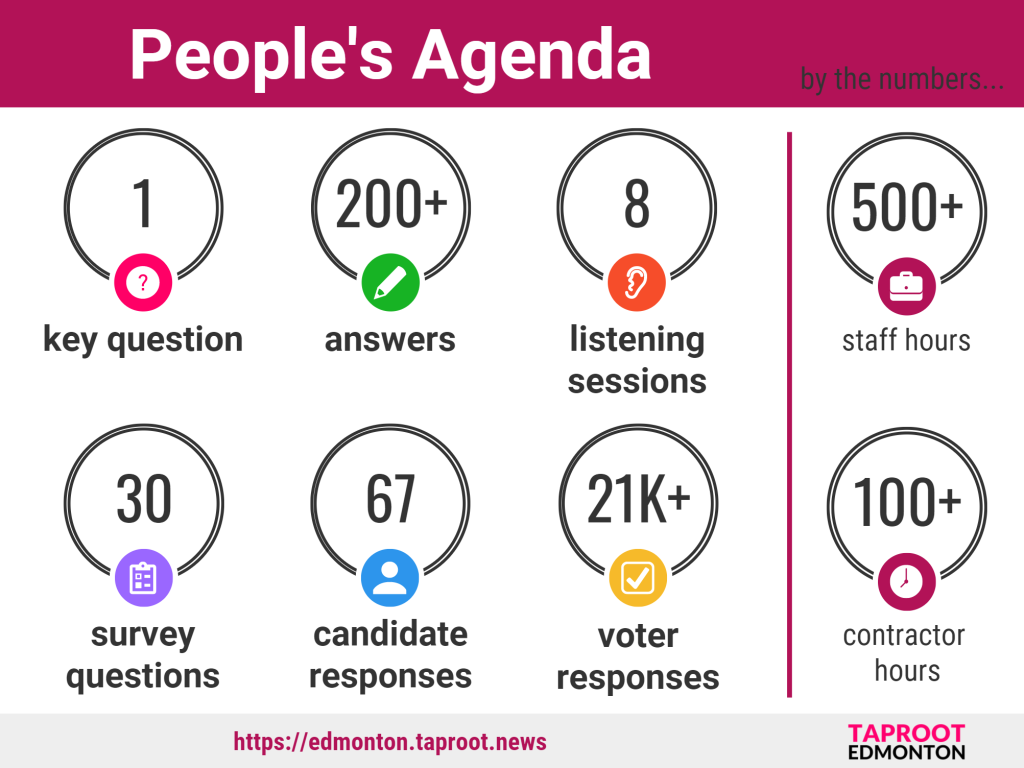
Some of the key facts and figures for the People’s Agenda project.

Lessons and challenges

This project took at least 500 hours of staff time and another 100+ hours from paid contributors, in addition to the time spent by steering committee members Elise Stolte and Rob Houle, as well as volunteer facilitators at our listening sessions.

It was at times overwhelming, but part of what made it so was not quite knowing where we were headed. There was a bit of wheel-spinning after our listening sessions, for example, when it wasn’t at all clear what our tiny team was going to be able to do with all of this input. The breakthrough was coming across The City’s Meet Your Mayor app, which inspired our own version.

It’s also worth noting that our startup changed significantly during the course of this project. In the summer of 2020, when we started the Election SOS training, our journalistic output consisted of several weekly newsletters on specific topics, a weekly podcast, and semi-regular stories that we shared on social media but didn’t have a very accessible home on our website.

In January 2021, we launched The Pulse, a weekday newsletter focused more generally on what goes on in our city. We had also revamped our home page to better display our journalism. That was vital to ensuring the project had impact. But The Pulse and the People’s Agenda weren’t as integrated as they could have been. Future engagement efforts will have to be fully part of what we do instead of happening in parallel as this project sometimes did.

While all of this was happening, we were also developing and delivering on the business-to-business product that helps to fund all of this work. That was vital, too, for while the project did sell some more memberships and increased our readership, which helps sell sponsorships and advertising, it did not pay for itself. Our model is such that the journalism is subsidized by the B2B side of our operation, and the growth we achieved earlier this year certainly made such an ambitious project possible. It would be fair to say, however, that the effort to bring the project to a strong conclusion ate into the time that we intended to put into business development in the last quarter.

We are coming out of this project with a reusable matching engine that we intend to employ not only for the next municipal election in 2025 but also in the interim, perhaps for elections at other levels or as a regular check-in on the current council. It may even be a product we could sell to others.

We have also developed a bit of a listening methodology that we’ll be able to streamline for future elections as well as ongoing check-ins on what matters to our community and what people want to better understand. We’re working on what that looks like. What we know for sure is that democracy is not just for election time, and neither is engaged, community-focused journalism. The People’s Agenda has taught us a lot about that. We’re eager to continue to apply those lessons as we go on.

What’s next

We encourage you to subscribe to The Pulse. You’ll receive our ongoing coverage of Edmonton and you’ll be among the first to participate in any new engagement opportunities. If you’d like to help ensure this work remains free for everyone, become a member.

If you’d like to know more about how we inform and connect communities, get in touch. We’d love to serve your community through our B2B offerings.

Finally, if you run a digital news site, work in journalism, or simply have ideas for how to make use of our matching engine, we’d love to hear from you.

By the numbers

  • 1 key question
  • 204 answers
  • 8 listening sessions
  • 10 topics
  • 30 survey questions
  • 67 candidate responses
  • 21,000+ voter responses
  • 500+ hours of staff time
  • 100+ hours of paid contributor time

A cascade of interest greets Taproot’s election matching engine

We are buoyed and blown away by the response to the Taproot Survey, our matching engine to help Edmonton voters discover how well they align with the candidates running for mayor and city council.

As I write this, we’ve received more than 6,800 responses, with more coming in every minute. That’s an order of magnitude greater than the goal we set when we conceived of the idea. A tremendous amount of work has gone into this project over the past year, and it’s gratifying to see it pay off to such a high degree.

Responses have been pouring in since we launched the Taproot Survey, a matching engine for Edmonton voters and candidates running for mayor and city council in the 2021 election. (Mack Male/Flickr)

How did we get here?

The survey is the culmination of the People’s Agenda project that we started more than a year ago. We asked Edmontonians what key issue they wanted the candidates to talk about as they competed for their votes in the 2021 municipal election. Those responses roughly coalesced into eight questions, which then formed the basis of a series of listening sessions to help us further understand people’s concerns.

The next step was to figure out how to determine where the candidates stood on these issues. Taproot co-founder Mack Male came across the Meet Your Mayor app from The City in New York. Because he is a developer himself, Mack said with his customary confidence that we could build something like that for our election. So we set about making it so.

How did we make it so?

Based on the input from our initial question and the subsequent listening sessions, as well as our own knowledge of civic affairs, we came up with a list of questions aimed at sussing out where the candidates stood and how they might be different from each other.

For the matching engine to work, we needed the questions to be multiple-choice. (Maybe machine learning will allow us to analyze unique sentences and match them with voters’ responses by 2025, but that wasn’t an option this year, much to some candidates’ chagrin.) We wanted those choices to stay away from motherhood statements — everyone wants a better city, no? — and we tried to make sure the answers were mutually exclusive and grounded in reality. We wanted the survey to be substantial and wide-ranging but not prohibitively long, so we landed on 10 topics with three questions each. Finally, we wanted to provide a short paragraph of context with links to further information to ensure that both candidates and voters understood the question we were asking.

This took a lot of time. Probably more than our small team could afford. But the prospect of having an easy but meaningful way for voters to find out who agreed with them on the issues spurred us on (along with a little bit of sunk-cost fallacy, if we’re being honest). We also benefited from excellent data-crunching from Madeleine Stout, and sage advice from Prof. Jack Lucas at the University of Calgary; our People’s Agenda steering committee members, Rob Houle and Elise Stolte; and Speaking Municipally co-host Troy Pavlek.

It’s been a long journey, but the train is finally coming into the station on our People’s Agenda project. (Mack Male/Flickr)

Then what happened?

Once the survey was finalized, we had to get the candidates to answer it. To me, this was perhaps the scariest part of this endeavour. Without a significant response rate from them, all of that work would have been for naught.

Step 1 was to make a well-considered, professional product. Step 2 was to make the case for the candidates to make time for our survey amid the plethora they had already received from others, not to mention the many other duties associated with campaigning. Some took more convincing than others, but by the time we were ready to open the survey to voters, we had half of the candidates, and we’re up to three-quarters now, including all but one incumbent.

Meanwhile, Mack and our technical intern, Meenakshi Chaudhary, were building the rest of the engine and website. That was a lot of work, too, but it will pay dividends, not only now but for future elections. We try to build replicable systems at Taproot, and this was no exception.

We soft-launched on Sept. 23, and opened it up to the wider public on Sept. 24, hoping but not knowing it would be well-received. It was. Deepest thanks to everyone who has shared the survey on social media, in newsletters, or by email. The magnitude of the response so far is because of you.

What’s next?

We’re going to keep collecting responses, from both voters and candidates, until election day on Oct. 18. Along the way, we’ll be writing stories arising from the data. Be sure to subscribe to The Pulse so you don’t miss a thing. (P.S. You can have more fun with the data yourself if you want — here’s how.)

Speaking Municipally, our municipal affairs podcast, will also be diving into the survey every Friday until the election.

Mack is planning to feed some of the data into our election night dashboard, which means Taproot will have not only the city’s best visualization of the data from Edmonton Elections (if past years are any indication), but also unique insights that you won’t find anywhere else.

Once the mayor and council are elected, you’ll be able to see at a glance where most or all of the winning candidates stand on these issues, which are likely to come up again over the next four years.

Finally, we’ve learned so much during this election campaign that we can apply to future ones. So watch for us to continue to build on this foundation in the years to come.

The People’s Agenda project enters its next phase

We’ve been doing a lot of work on the People’s Agenda project, but we haven’t been doing much of it out loud lately, so it’s time for an update.

We’re grateful to the hundreds of people who answered our question about the issues that matter to them and participated in the eight listening sessions we organized around those responses. They conveyed so much passion, intelligence, and curiosity to us, all of which is fuelling the next phase of this project.

As we noted in our previous progress report, the next steps are to generate a voter’s guide indicating where the candidates stand on the issues people told us they cared about, and to publish stories further examining some of the issues we heard about.

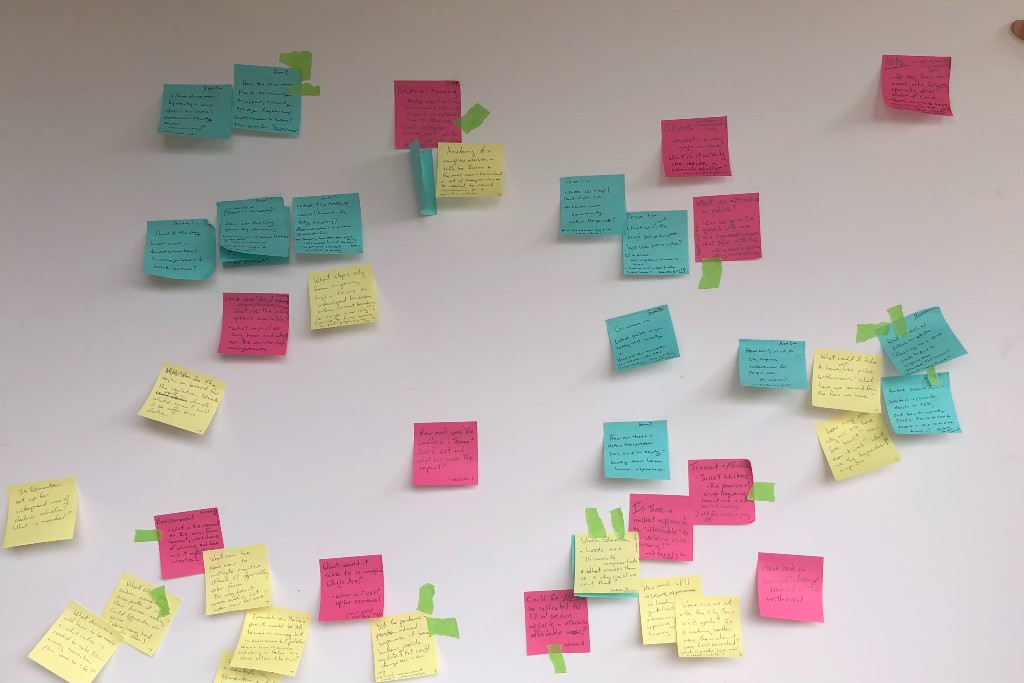
Processing all of the information we’ve received from Edmontonians through the People’s Agenda project has involved a lot of spreadsheets and sticky notes. This is from a recent feature story brainstorming session.

Foundation laid for voter’s guide

We have developed a questionnaire that we will be asking candidates to fill out indicating where they stand on various issues, derived from what we heard from participants in the People’s Agenda and bolstered by the close attention we pay to city council. The questionnaire consists of 30 multiple-choice questions organized in groups of three under 10 headings: economy; environment; finances; housing and homelessness; planning; police; politics and governance; quality of life; roads; and transit.

The questionnaire doesn’t cover every issue that was raised in our gathering phase, but we’ve done our best to create a representative sample with a range of answers that will allow candidates to demonstrate their values and the approaches they would take to matters that the next city council will face. We will also invite them to share a pitch to voters, which we will publish along with their answers to the survey.

Our desire is to create an interactive guide similar to what a site called The City created for New York’s recent mayoral election. The City compiled candidates’ answers, and then made the same questionnaire available to New Yorkers so they could learn which candidates were most aligned with them. We are working to generate a similar experience so Edmontonians can find out which candidates for their ward and the mayoralty are the best fit for them.

The questionnaire will be sent to candidates soon. If you are running, please fill it out — we will be sharing the results far and wide, and this will help you find your voters. If you are working for a campaign, please make sure your candidate fills it out. And if you are a voter, kindly nudge them to fill it out.

Stories are in the works

We’ve published the first feature story inspired by People’s Agenda participants: This social-services experiment is working — could there be more?. The idea to take a closer look at the C5 North East Hub came out of a discussion during our listening session on housing and homelessness. As reporter Jackson Spring discovered, the hub seems to be working for people in a part of the city that needs support and doesn’t have easy access to it, but its future depends on whether the next city council decides to fund it.

We’ve got some other features in the works on such issues as 15-minute districts, public toilets, and carbon accounting. The answers to our questionnaire will also yield stories about each ward and act as a jumping-off point for deeper examinations of the questions at play.

More election-related matters

We’ve started a regular feature in The Pulse called the municipal election rundown, gathering up what the candidates are up to. Right now, that runs on Thursdays. Subscribe to The Pulse to get it for free every weekday.

You’ll also hear an increasing amount of campaign coverage on Speaking Municipally, our award-winning weekly look at municipal issues in Edmonton, hosted by Troy Pavlek and Mack Male. That comes out every Friday at noon.