Introducing Taproot Edmonton’s Business Membership

The Edmonton region is facing a significant challenge: a lack of coverage of the people and organizations shaping our community’s future. With fewer resources dedicated to telling these important stories, everyone is missing out on vital information.

At Taproot Edmonton, we are committed to informing and connecting people across the Edmonton region through original reporting, newsletters, podcasts, and our recently launched events calendar.

Today, we are excited to introduce our new Business Membership program, designed to enlist the business community’s help to fill the knowledge gap and thus build a more informed and connected community.


Why is there a lack of business coverage?

Since 2008, nine local news publications in Edmonton have closed and another seven have decreased their coverage, according to the Local News Research Project. Just four local news publications have launched during the same period, including Taproot Edmonton.

The situation across the region is even more dire, where existing publications were much smaller to begin with. In addition to local news, we’ve also lost business-focused publications such as Alberta Venture.

These were the headlines in March 2017 — things have only gotten worse since then. (Mack Male/Flickr)

In the past, local news outlets published more stories about what businesses and other organizations were up to. But as their resources have shrunk, business coverage has tended to fall by the wayside as assignment editors focus on what they consider core subjects: crime, politics, and sports. As a result, there are few if any local beat reporters in our region focused solely on business.

We need a more intentional approach to ensure that local stories of innovators, entrepreneurs, and changemakers are told.

What is Taproot doing to address this gap?

We have been working to build the infrastructure required for impactful local beat reporting since we started.

For example, we already pay more attention to local business than anyone else. We publish dozens of original stories about business every month, and we publish the Business Roundup every Friday morning. News about local business and economic development is also a key part of several other roundups, including the Tech Roundup and the Regional Roundup.

Business is often discussed on our weekly municipal affairs podcast, Speaking Municipally, and in the past we have published an entire podcast focused on local innovation businesses (and we’re interested in reviving that).

We also curate hundreds of business-related events on the Taproot Edmonton Calendar.

We reach thousands of people every day through The Pulse and our other publications. Every time another local publication follows our story with their own version (which happens with increasing frequency), more people learn about the Edmonton region.

But imagine the impact we could have with more resources to boost local news coverage and grow our audience.

What is the Business Membership program?

We want to enlist members of the business community as partners in our effort to enhance local news coverage and broaden our reach. By purchasing a business membership, you help ensure ongoing, smart, comprehensive coverage of the local community and support the infrastructure needed for continuous storytelling.

We offer four membership tiers:

  • Starter (up to 15 employees): $100/person per year
  • Small (up to 49 employees): $1,500 per year
  • Medium (50-199 employees): $3,500 per year
  • Large (200+ employees): $7,500 per year

Each tier allows you to add your team members to Taproot’s mailing list. That means they’ll be better informed and connected, and it helps us grow our audience.

The financial support and increased readership will help a great deal, but we also want to hear from you about what you’re seeing in the local news ecosystem. We plan to host a quarterly summit for business members to discuss gaps, challenges, and ideas.

What are the benefits of joining the Business Membership program?

As a business member, you will:

  • Support local journalism and ensure that important local stories are told.
  • Equip your team with the latest news and events in the Edmonton region.
  • Enhance your brand’s visibility through recognition in our newsletters and on our website.
  • Receive advertising credits for use in Taproot Edmonton’s publications.
  • Optionally participate in quarterly summits to discuss gaps and challenges in the local news ecosystem.

In short, you’ll be making a significant contribution to a more informed and connected Edmonton region.

How can my business sign up as a member?

To join, simply fill out this form with your business name, contact information, and preferred membership tier. Then we’ll follow up to activate your membership.

How will you use my membership fees?

We’re a business too, so we understand you expect value for your investment.

We will invest membership fees primarily in marketing and product development to grow our audience and enhance our offerings. This will in turn broaden our reach and impact, which will help us attract more members, sponsors, and advertisers. That’s the flywheel we’re trying to get spinning to support local journalism in the Edmonton region.

Does this mean Taproot will only write positive things about business?

No, our allegiance remains to the reader, regardless of where our revenue comes from. We will continue to cover all aspects of the business community, including challenges and opportunities for improvement. We adhere to the ethics guidelines published by the Canadian Association of Journalists and believe that transparency is key to building and maintaining trust with our readers, members, and other stakeholders.

What if I don’t have a business?

We invite you to join Taproot Edmonton as an individual member. For just $100 per year, you can support local journalism for the Edmonton region. Learn more and sign up here.

Who can I contact for more information?

For more details or to discuss further opportunities, please reach out to Mack Male and Karen Unland:

  • Mack Male — mack@taprootpublishing.ca — 780-619-3864
  • Karen Unland — karen@taprootpublishing.ca — 587-986-5442

Supporting local journalism is crucial for maintaining a vibrant, informed, and connected community. We encourage you to become a business member today to help us boost local storytelling in the Edmonton region.

Thank you for your support!

The Taproot Edmonton Calendar will transform how Edmontonians discover local events

We created the Taproot Edmonton Calendar to tackle a significant challenge within our community: the fragmentation and inaccessibility of local event information.

We have heard repeatedly that people struggle to know where to look for information about upcoming events. And when they do find out about events, it is often too late to participate. That’s a problem because events are a vital part of our community, bringing people together, fostering connections, and supporting local businesses and organizations.

We set out to address this challenge by creating a high-quality, comprehensive, and easy-to-navigate calendar of events taking place across the Edmonton region.

Taproot picks at the Taproot Edmonton Calendar on May 7, 2024.

Is it really that hard to find local events?

Despite the wealth of events taking place in Edmonton, many people do indeed struggle to discover and participate in them.

Last year, we surveyed 350 people in our community and found that 65% of respondents rated the current experience of discovering events to be either poor or fair. Just 9% told us the experience was very good or excellent. Additionally, 53% of respondents said they frequently or always discover interesting events too late.

Here are just a few of the responses we received:

  • “It’s difficult finding out what is happening in the city. Sometimes I find out the day it starts, and it’s too late to attend.”
  • “When I am looking for something specific, I can find things, but when trying to browse casually it can be hard to find anything.”
  • “I usually know about big events and events in my direct community, but often miss out on finding new things.”
  • “You have to search numerous websites and be very curious and have the time to do both.”
  • “It often feels like my knowledge of upcoming events is limited by whether I see it on social media or not.”

Our research revealed several other insights, too. Aside from friends and family, the most common way that respondents told us they discover events is through email newsletters. But email newsletters have their own discovery challenges, and the more you subscribe to, the harder it is to keep up. Facebook and other social media platforms were not far behind as a source, but with those tools, you’re at the mercy of the algorithm to surface events that might interest you in a timely fashion.

When asked about existing event calendars and listings, respondents told us they are often incomplete, difficult to navigate, and lack accurate information. Many people also expressed frustration with quality, noting that many sources are “noisy” and filled with irrelevant or uninteresting events.

How does the Taproot Edmonton Calendar fix this?

Our goal is for the Taproot Edmonton Calendar to be that single, curated, and accessible service that helps people discover and participate in local events.

We took an important step toward that goal by launching the calendar in beta in December 2023. We focused on building a solid foundation with a clean, user-friendly design, and some initial tools for categorizing and filtering events. The calendar builds upon our existing web platform to help ensure it is accessible and responsive, which means it works well on any device.

Here are a few of the features we’ve built into the calendar so far:

  • Rich event details: Every listing includes the essential information you need to know, such as the date, time, location, a brief description, and a link to learn more. Where possible we also include images, links to tickets and livestreams, pricing information, and more.
  • Categories and tags: We established nine top-level categories to help you find events that match your interests. We’ve also added tags to help you filter by more specific topics.
  • Related events: Most event listings also include a list of related events, so you can easily discover other events that might interest you.
  • Taproot picks: Our team curates a list of events we think are particularly interesting or relevant. These Taproot picks are featured prominently on the calendar.
  • Basic filtering: You can filter events by category, date range (such as “today” or “next week”), city, and whether the event is in-person or online. You can also see all events taking place at a specific location, or organized by a specific organization.
  • Flag for review: Despite our best efforts, we know that mistakes happen. If you spot an error or have a concern about an event listing, you can flag it for review by our team.
  • Event submission: We’ve made it easy for event organizers to submit their events to the calendar. All we need is a URL and our system and team do the rest. It’s free, quick, and easy.

We have lots of ideas for how to improve the calendar further. Based on feedback from early adopters, we’re already working on new layout options, search, more robust filtering, and personalization features, among other things.

One of the first improvements we made this year was to integrate the Taproot Edmonton Calendar into The Pulse and our weekly roundups. Now you can find a curated selection of upcoming events in each newsletter, and you can click through to the calendar to see more.

But most of our effort over the past few months has been focused on growing the number of events in the calendar. We now have thousands of events listed, and we’re adding more every day. About 20% to 25% of our listings are for events that will take place at least 30 days from now, to help you plan ahead.

Why Taproot?

We believe Taproot is uniquely well-positioned to tackle this challenge. Our mission to help people understand their community better perfectly aligns with the goal of the calendar. Over the past few years, we have developed sophisticated systems and processes to support the curation of local information, including events. And we have a growing team of talented individuals who are passionate about informing and connecting Edmontonians, including Debbi Serafinchon who is our point person for the calendar.

But perhaps most importantly, this is a challenge that we have experienced ourselves. We know how frustrating it can be to miss out on an event because you didn’t hear about it in time, and we know how hard it can be to find events that match your interests.

Y Combinator co-founder Paul Graham wrote last year that “if you’re making something for people, make sure it’s something they actually want.” The best way to do that? “Make something you yourself want,” he wrote.

That’s what we’re doing. We’re building the Taproot Edmonton Calendar because it’s something we want, and we believe it’s something our community wants too (and our research backs that up).

We’re excited by the opportunity to boost our impact as part of the connective tissue that makes the city work. The calendar reflects our ongoing commitment to not only inform the city but to be an active participant in its story, weaving together the many threads that make Edmonton a great place to live, work, and play.

How can I help?

We encourage you to check out the Taproot Edmonton Calendar and start using it to discover local events. If you like what you see, please help us spread the word by sharing the calendar with your friends and family.

We are committed to keeping the calendar free for everyone to use, but there are real costs associated with building and maintaining it. If you’re in a position to support our work, we would love to have you as a Taproot Edmonton member. Your membership helps fund the calendar and our broader mission of supporting local journalism in Edmonton.

If you’re an event organizer, we encourage you to submit your events to the calendar. It’s free, quick, and easy, and it helps ensure that your event reaches a broader audience.

If you’re a business or organization that wants to work with us to support the calendar, we would love to hear from you. We offer a range of sponsorship opportunities that can help you increase your visibility while supporting a vital community resource. Please reach out to us to discuss how we can collaborate to keep Edmonton vibrant and well-informed.

Lastly, we welcome your feedback and ideas for how we can make the calendar even better. Please don’t hesitate to get in touch with your thoughts.

Meet Taproot Edmonton’s new managing editor

We’re happy beyond measure to introduce you to Taproot Edmonton’s new managing editor, Tim Querengesser.

Tim has an extensive background in journalism, including two years as managing editor of the now departed Metro Edmonton. He left that job in 2017 “because I felt the entire legacy newspaper model was no longer working in the way I had experienced in happier days, especially those at my first reporting gig at the Yukon News, still one of my favourite papers for its values and approach,” he said.

Most recently, Tim was the senior advisor for communications and engagement at the Edmonton Federation of Community Leagues. But his heart remained with journalism, and Taproot has turned out to be his path back to the newsroom.

“I feel connected to the values, the approach, the unapologetic fascination with Edmonton minutiae, and the sustainable thinking behind the business,” he said.

Tim will take over responsibility for the day-to-day operations of Taproot Edmonton’s journalism, marshalling his wealth of experience to guide our editorial team and freeing up the founders to concentrate on continuing to build a sustainable business.

A smiling man squatting in a bike lane on a sunny fall day in Edmonton
Tim Querengesser is Taproot Edmonton’s new managing editor.

We often talk about Taproot as part of the connective tissue that makes our community work better. That approach aligns with the way Tim thinks.

“I see my ultimate job in all of the many things I do as making my community a better place,” he said, noting his past involvement in the Edmonton Wayfinding Society, his efforts to bring bike-sharing to the city, and an e-bike maintenance workshop he recently hosted. “In the past, being this involved was kind of taboo for journalists. I think it’s what has opened my eyes to different audiences and communities.”

That said, Tim is hardcore when it comes to finding stuff out and telling people about it, and has been since he was very young, raised by an inveterate newspaper reader and a typewriter repairman.

“I read newspapers early, I wrote things — often on a typewriter — from a young age, and I formed ideas early,” he said. “I remember reading my first essay on world politics to my rather bewildered Grade 5 class.”

Meet Taproot Edmonton’s new curator/reporter

More good news! We have welcomed Stephanie Swensrude to Taproot Edmonton’s growing editorial team.

Stephanie comes to us from Corus Entertainment, where she worked as a reporter and content coordinator in the newsroom serving 630 CHED and Global News Edmonton. Before that, she was a multimedia journalist in Kamloops, B.C., a job she landed after graduating from the radio and television program at NAIT.

“I had always cared a lot about politics and social issues, but I didn’t see many of the other people my age engaging in news,” she said of the path that led her to us. “Then when the pandemic hit, people became way more involved, and it really showed me how important journalism is.”

At first, she thought she wanted to be a TV news anchor, but working at the NAIT Nugget changed her mind. “I quickly realized I would rather be talking to people out in the community.”

Stephanie will wear a few hats at Taproot. She has taken over responsibility for the items in our weekly roundups. She’ll also report and write stories, and she’ll appear now and then on Speaking Municipally, as she did in Episode 238. (Tune in not only for a geek-out on transit and zoning but also for co-host Troy Pavlek’s reaction to her pitch-perfect radio voice in the rapid-fire jokes at the end.)

Stephanie Swensrude joined Taproot as a reporter and curator in October 2023. (Supplied)

Stephanie has already gathered a few bylines, covering an Edmonton Downtown Business Association luncheon on attracting retail to the core, writing up the results of the Start Alberta Tech Awards, and sharing some of the newsiest bits of Let’s Find Out’s recent live show.

Stephanie will also be writing our weekly “On the agenda” feature, as she did on Oct. 23, summarizing what’s coming up at city council and its committees for the coming week.

“I’m a huge city council nerd, and it’s my favourite thing to report on,” she said. “I love how Taproot endeavours to get people to care more about the important decisions being made at city hall.”

Welcome to the team, Stephanie!

Taproot co-founder helping to update Canadian journalism ethics guidelines

Karen Unland, Taproot’s co-founder, is bringing her perspective as a leader of an independent journalism startup to the future of ethics guidelines for Canadian journalists.

Karen has served on the Canadian Association of Journalists (CAJ) ethics advisory committee since September 2021. Board-appointed, the committee exists to provide advice on ethical issues faced by Canadian journalists in their regular work. Its 11 members, drawing on experience in independent and mainstream media and academia, meet about once a month to discuss key issues and develop policy and discussion papers.

“Something that has emerged, for me,” said Karen, “is an appreciation of how smart the committee members are and how deeply they think about these issues. It is intellectually stimulating to have these discussions.”

Karen said the committee offers a space for “sober second thought away from the thrust of daily decision-making” and allows members to thoroughly interrogate the profession’s foundational principles and practice. One recent discussion paper, for example, sought to define the meaning of journalism to capture dramatic transformations and growing diversity in the kinds of activities that could be considered journalistic work.

In early 2023, Karen joined a subcommittee to review the CAJ’s Ethics Guidelines. This widely cited document, which is designed to help new and seasoned journalists hold themselves accountable for their professional work, has not been updated since 2011.

“This is the sort of topic that I like to nerd out about,” said Karen. “Although I am not the only representative of independent media, I thought it would be valuable to bring perspective from someone working in an emerging newsroom and running a journalism business.”

Taproot co-founder Karen Unland moderated a discussion on updating CAJ’s ethics guidelines at the 2023 CAJ conference in Vancouver. (Supplied)

Karen’s participation also took her to Vancouver in mid-April for the CAJ’s annual conference. She moderated a panel featuring fellow committee members Pat Perkel and Anita Li. Perkel is a former executive director of the National NewsMedia Council and a veteran of small newsrooms in northern Ontario; Li is the founder of a hyperlocal community-driven publication called The Green Line and a journalism innovation newsletter called The Other Wave. They outlined how they are approaching the revision of the ethics guidelines and solicited opinions for working journalists in the audience about how they use them.

Taproot is helping to shape the future of the industry

Karen said she is approaching the review of the ethics guidelines in much the same way as Taproot approaches its work, by focusing on the end user. That means considering how to make the guidelines as useful as possible to journalists who may be working in new newsrooms or depleted ones that lack institutional memory or robust policies of their own.

“I think we’ve made some really decent progress around updating the guidelines for the world we find ourselves in right now,” said Karen, “and future-proofing them a bit for things that come along that we can’t yet anticipate.”

Karen is grateful to the CAJ for this opportunity to take part in national conversations shaping the future of our industry.

“We want to reassure our readers that Taproot is here for the long haul,” said Karen. “We conduct our work the best we can and with a view to continuous improvement. Because of this, we are increasingly able to access opportunities and share what we know and learn with others.”

Correction: This file has been updated to more accurately describe The Green Line.

Let’s Find Out joins Taproot Edmonton

Let’s Find Out, the award-winning podcast that explores Edmonton’s history through listener questions, is joining Taproot Edmonton!

Let’s Find Out is hosted by Chris Chang-Yen Phillips, who served as Edmonton’s fourth historian laureate, and is co-produced by his longtime collaborator Trevor Chow-Fraser. Since it launched in 2016, the show has tackled a wide range of topics across its 63 (and counting!) episodes. For example, Episode 21 looked at green onion cakes, Episode 42 explored the icons of Ritchie, and Episode 60 — which featured a question from Taproot co-founder Karen Unland — looked at how garbage dumps in the river valley were transformed into parks.

The April episode of the monthly show answers a question about how to make parks more fun in the winter, which creates an opportunity to consider the decade-old Winter City Edmonton initiative.

Let’s Find Out and Taproot Edmonton collaborated on a live event in 2019. (Mack Male/Flickr)

We at Taproot have been fans of Let’s Find Out for a long time. We sponsored the show’s 2019 season, which explored how nature shapes us, and we collaborated on a live event — complete with a story garden! — to kick it off.

The end of the Alberta Podcast Network presented an opportunity for us to explore a deeper collaboration. The curiosity-driven approach of Let’s Find Out is a perfect fit for Taproot, and we’re thrilled to be able to support Chris and Trevor as they continue to explore Edmonton’s history.

Over the next few weeks, we’ll integrate Let’s Find Out more closely into our operations. Fans of the show can expect more great episodes, and we are excited to bring the stories of Let’s Find Out to a wider audience via our website and The Pulse.

Welcome to Taproot, Let’s Find out!

Declaring our roundup experiment a success

We’re declaring the experiment we started last month a success. Now when you open a roundup, you’ll find a message from a member of our team pulling some threads together in the Taproot way — with curiosity and desire to understand our community better.

Thank you to everyone who provided feedback. Here’s a sample of the things we heard:

  • "I love the new roundup format."
  • "I really like the new opening perspective from the editor."
  • "I’m writing to tell you I’m enjoying the new format of the roundup. I think it’s a great addition."

We’re grateful for the evidence that this approach is working!

Our previous format was to include a story at the top of the roundup, which meant there was duplication between the roundups and The Pulse. We want to encourage you to subscribe to The Pulse for a daily look at what’s happening in Edmonton, and to the roundups for deeper dives into what’s happening in tech, food, health innovation, the region, the arts, and business. The new format makes that more likely.

“I like to start my notes to you as if we’re in the middle of a conversation,” Meg Ryan’s character says in You’ve Got Mail.

We think the new format makes the roundups themselves more engaging. Instead of dropping you right into a story, we greet you in a more conversational way without any unnecessary preamble (as we always strive to save you time). I’m reminded of Meg Ryan’s character in You’ve Got Mail, who writes to Tom Hanks’s character, "I like to start my notes to you as if we’re in the middle of a conversation."

One of the things we’ve learned through the experiment is that this format is a useful way for us to connect the dots. While each edition of a roundup is informative on its own, paying attention to a topic over time yields greater benefits. We notice patterns, connections, and trends that we can share, and the new format is a good way to do that.

What’s next?

We’ll still write stories about our roundup topics even with the new format in place, and you’ll still find them curated into items for the roundups they fit best. Those stories will also make it into The Pulse. But the new format provides us with some operational flexibility that we’re excited to take full advantage of.

For instance, in The Pulse you’ll increasingly find stories like our look at the community sandbox program, which doesn’t exactly fit one of the roundup beats. It also means we can publish stories like today’s about Future Fields securing US$11.2 million in funding whenever it makes sense to do so, not just because it fits a particular day’s roundup.

We’re working on additional improvements to the roundups, The Pulse, and our website, and we’ll have more to share on that soon. If you have any feedback on what would make the reader experience even better, please let us know!

And as always, if you’d like to help us go further faster, become a Taproot member or sponsor. You’ll be helping us build what comes next in local journalism.

Kicking off 2023 with an experiment

We’re trying something new at the top of some of our roundups, as part of our continuing quest to build a sustainable, tech-enabled media business that helps our community understand itself better.

Taproot is experimenting again, as we are wont to do. (Alex Kondratiev/Unsplash)

Instead of a story at the top of the Jan. 17 Food Roundup and the Jan. 18 Health Innovation Roundup, you’ll see a message from the editor pulling together some threads in a meaningful way. We pay a lot of attention to these topics, and sometimes we notice things that aren’t really stories and aren’t really items, but are still worth attention and context. That’s what we’d like to provide at the top of the roundups, in a way that’s more conversational than our usual editorial voice.

We’ll try this again with a couple of other roundups next week to see if we’ve hit on a format that will stick. We’d love to know what you think — send your thoughts to hello@taprootedmonton.ca.

Why are we doing this?

Change is the Taproot way. We started with long-form features inspired by readers’ questions, and we published them as soon as we had the time and money to put them out, which in the early days was at a pretty slow cadence. Then we introduced roundups, our weekly newsletters gathering items on specific topics, serving readers’ curiosity in a different and more frequent way and opening up a new revenue stream via sponsorship. Their format has evolved over time.

Two years ago, we launched The Pulse, a weekday newsletter that distributes our stories and curates news and items from other sources to help Edmontonians get on with their day in an informed way. That product has become the centre of our editorial work, and its readership is much higher than that of any roundup.

When we started The Pulse, it made sense to distribute the stories that we wrote for the various roundup beats in that newsletter, along with elements that are only distributed in The Pulse, such as some of our city council coverage, our weekly moment in history, and our event listings.

Now we’d like to differentiate the content of The Pulse from that of the roundups, partly for some operational flexibility but also because we think it will be a better experience for readers. We want to encourage you to subscribe to The Pulse for a daily look at what’s happening in Edmonton, and to the roundups for deeper dives into what’s happening in tech, food, health innovation, the region, the arts, and business. You may have a greater incentive to do that with less duplication.

Will we still have stories on our roundup beats?

Many of our story ideas emerge from the topics our readers want us to pay attention to, so we will naturally continue to cover stories that fit our roundup beats, whether this new format sticks around or not. Those stories will continue to be curated into items for the roundups they fit into, as is our practice now.

This gives us the flexibility to publish daily stories that aren’t necessarily related to or timed with a particular roundup. We think this could improve the quality of our work.

What’s next?

We’ll experiment with this for a couple of weeks, then make a call on whether to keep doing it. If we do, that will likely lead to some other changes we’re considering to improve the experience for readers and paying members.

As always, if you’d like to help us go further faster, become a Taproot member or sponsor. You’ll be helping us build what comes next in local journalism.

Speaking Municipally shortlisted for Canadian Podcast Award

Vote for Speaking Municipally in the Canadian Podcast Awards before Aug. 10, 2022!

We’re proud to see Speaking Municipally once again nominated for a Canadian Podcast Award.

Mack Male and Troy Pavlek have been paying close attention to city council on Edmontonians’ behalf since August 2018. It’s wonderful to see all of their hours of watching meetings and combing through agendas rewarded with this recognition, as it was when the show was nominated last year.

The Canadian Podcast Awards are voted on by other Canadian podcasters. If you happen to be one of those, you could cast your vote for Speaking Municipally in this category: “Outstanding News & Current Affairs Series.” Voting closes on Aug. 10, 2022.

While you’re there, consider voting for fellow Alberta Podcast Network members Putting It Together, Makeshift Stories, Quantum Kickflip, and 2 and Out.

There’s strong Edmonton-area representation among the other nominees, including The Smile Syndicate and Water We Doing, as well as a couple of podcasts we’ve written about before: Canadian History Ehx and Super Awesome Science Show.

By the way, Taproot has another show you might want to check out: Bloom, a podcast about innovation in Edmonton. We’re up to 25 episodes now, featuring interesting conversations with folks such as Jalene Anderson-Baron of Future Fields, Brian Heath of Drivewyze, Chris Kallal of Wild + Pine, and Tiffany Linke-Boyko of Flying Fish Partners.

Here’s something city council can do right now to support local journalism

Edmonton’s city council passed a motion on June 7 that we didn’t cover over at Taproot Edmonton, but we certainly took note of as a local media company.

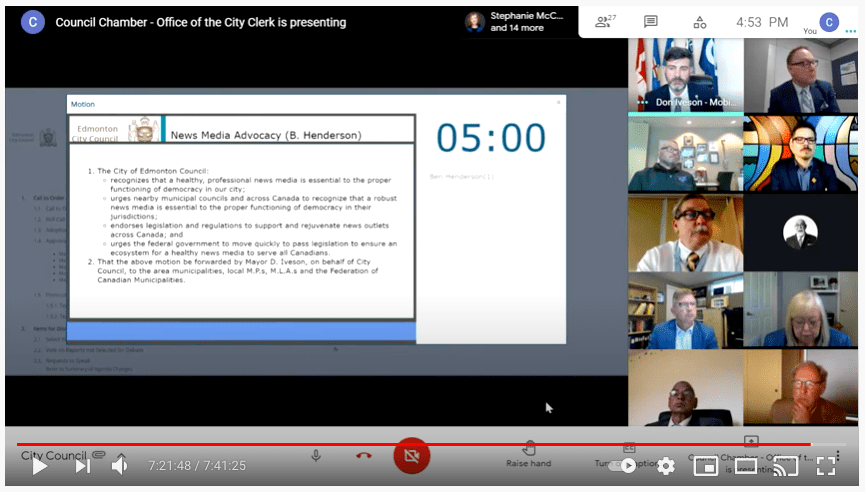
The motion, made by Coun. Ben Henderson and seconded by Coun. Scott McKeen, carried 13-0. Here’s what it says:

The City of Edmonton council recognizes that a healthy, professional news media is essential to the proper functioning of democracy in our city; urges nearby municipal councils and across Canada to recognize that a robust news media is essential to the proper functioning of democracy in their jurisdictions; endorses legislation and regulations to support and rejuvenate news outlets across Canada; and urges the federal government to move quickly to pass legislation to ensure an ecosystem for a healthy news media to serve all Canadians.

Edmonton City Council meeting, June 7, 2021

Henderson said similar motions have been passed by municipalities across the country. This campaign coincides with an effort by News Media Canada to step up pressure on the federal government to pass legislation to "rein in" Google and Facebook before Parliament rises for the summer amid anticipation of a fall election. The newspaper lobby would like something similar to what Australia passed earlier this year requiring Google and Facebook to negotiate compensation agreements with publishers.

Henderson said he didn’t know the specifics of the federal legislation. Nonetheless, the motion passed unanimously. That struck me as odd, but judging from the discussion, councillors were motivated by a desire to get on the record their recognition of the importance of local news coverage and the role that it plays in helping them do their job.

Fair enough. We agree that a healthy news media is essential to the proper functioning of democracy, and it means something for politicians to say that out loud, because they are often criticized by said media.

We should consider, however, whether the proposed cure is worse than the disease. As Joshua Benton pointed out in Nieman Lab, what happened in Australia is not all it’s cracked up to be. A bill in the Senate that aims to force the tech giants to pay royalties to Canadian journalism organizations is similarly flawed, as was eloquently explained by Sen. Paula Simons (a former Edmonton Journal colleague of both mine and McKeen’s) in a piece for The Line. It’s not clear that such a use of Canada’s copyright law would work, and even if it did, it would favour the incumbents. "At what point is it actually unfair to help big companies like Postmedia and Torstar and Bell Globe Media, while making it harder for new start ups and innovative news platforms to get a start?" she wrote. "Is there a point at which we simply have to acknowledge that the era of the big legacy newspaper companies is over?" In Taproot’s view, we have indeed reached that point.

A screenshot from the June 7 meeting where city council called on the federal government “to ensure an ecosystem for a healthy news media to serve all Canadians.”

Council can take action itself

At any rate, there’s not much we can do to influence what the federal government decides to do or not do on this file. However, there is action that our municipal government could take to strengthen the health of local journalism in our city.

The City of Edmonton buys a lot of advertising. Between 2008 and 2018, it spent well over $7 million on ads in the Edmonton Journal, and council’s executive committee agreed to renew an agreement for up to $3.5 million more over three years in November of 2018. We know these figures because the contract is big enough to have to go to council for approval. That agreement ends on Dec. 31, 2021.

A substantial proportion of that amount had been for "legally required advertising" — certain notices that the Municipal Government Act used to require the City to place in the main local newspaper. The act no longer requires this, and in October of 2019, city council passed a bylaw providing "alternative methods for advertising proposed bylaws, resolutions meetings, public hearings, and other things required to be advertised by the City." Now most of that legally required advertising can appear on the City’s website instead of in paid ads in the Edmonton Journal.

While the ostensible reason for advertising in the Journal was to reach a substantial proportion of the population as required by the MGA, the actual outcome was to subsidize Postmedia — a debt-ridden, Toronto-based company that has continually cut local journalism — in a way that has been unavailable to any of its competitors. What Taproot co-founder Mack Male told executive committee in 2018 remains true today: "Paying Postmedia for legally required advertising is effectively a subsidy to a single outlet. The opportunity here is to consider whether that subsidy should be reduced and whether it could be spread across multiple outlets, especially those who will invest the money in building a brighter future for journalism right here in Edmonton."

The City no longer has to spend as much on print ads as it used to, and its current agreement expires at the end of this year. It still has to make sure as many people as possible know what it is up to. And council just passed a motion saying that healthy local media outlets are vital to democracy. So this seems like an excellent time to use that spending power in a way that accomplishes these goals. Even a fraction of what has been allocated for advertising in Postmedia would make a huge difference to local media outlets like Taproot that inform the community and are part of the connective tissue that makes a city work.

To be clear, the City wouldn’t be buying influence with such purchases. Postmedia’s journalists feel free to criticize city council and administration, and so would Taproot’s and those at any other reputable media outlet. If there were strings attached to that money, we wouldn’t take it, and I don’t see any evidence that the City has or wants such strings. Some outlets choose not to sell any advertising at all; we do, with a clear moral compass that directs us to give up revenue if it puts the integrity of our journalism at risk.

And one more thing: With so much of the City’s communications now taking place on its own website and social media channels, it seems plausible that an ever-larger proportion of the advertising budget will go to search engine marketing and social media marketing. This is the advertising world we live in now, and it is why Google and Facebook have eaten newspapers’ lunch. But if council truly believes that something should be done to support local journalism, then it shouldn’t send all of its advertising budget to the tech giants either. Spend some of it here on the local media ecosystem.